

AI for Engineering Design: Why Your Team Needs to Know About GNUcleus AI
Curious what \"AI for engineering design\" actually means? A plain-English guide to GNUcleus AI, the platform turning text and images into editable CAD models 10-100x faster.
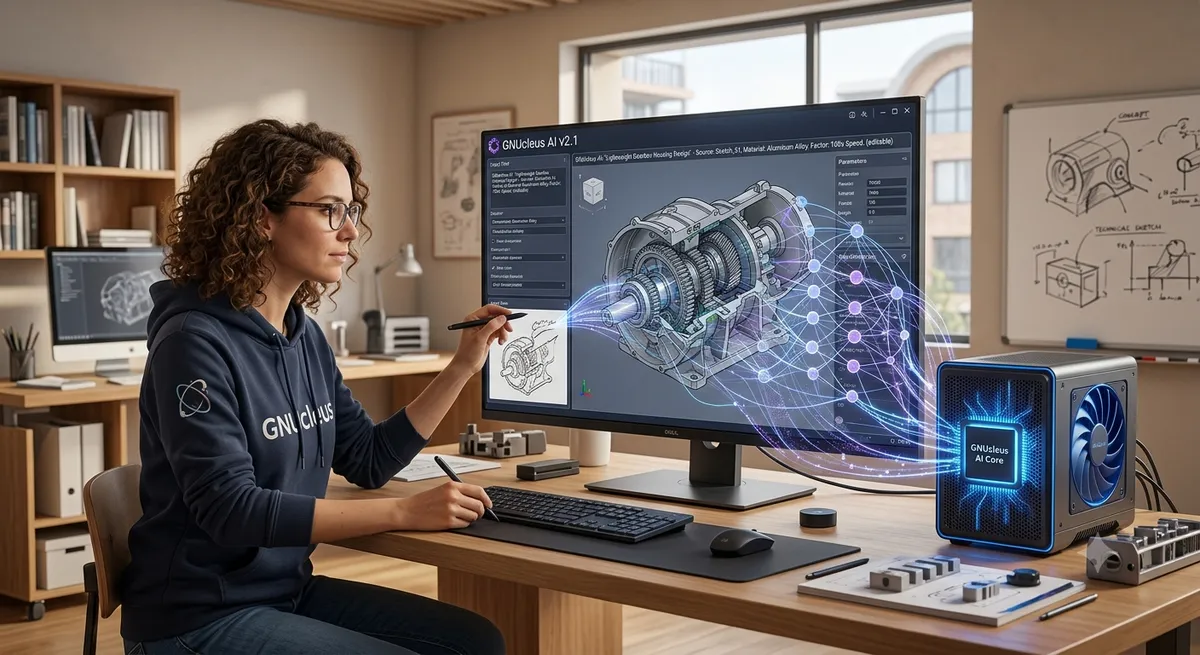
AI for Engineering Design: Why Your Team Needs to Know About GNUcleus AI
What if you could describe a product idea out loud and seconds later a detailed, fully editable 3D CAD model appeared on your screen? A few years ago that sounded like science fiction. Today, it's a real product from GNUcleus AI, a company based in Sunnyvale, California.
If you're a product manager, startup founder, or business leader who's heard vague talk about "AI changing manufacturing" but doesn't know what it means in practice, this guide is for you. No engineering degree required.
Here's the short version. There is an entire category of work that goes into turning a product idea into something that can actually be built — precise digital blueprints that factories use to manufacture physical objects. Historically this has been slow, expensive, and locked behind specialized software that takes years to master. GNUcleus AI is a generative AI platform that dramatically compresses that process: give it words or images, get production-ready 3D design files.
The speed at which a company can go from "idea" to "physical product" is one of the biggest competitive advantages in any hardware business. If your team can iterate on a design ten times in the time it used to take to do it once, you ship faster, waste less money on dead-end prototypes, and out-maneuver competitors still doing things the old way.
First, What Even Is CAD?
CAD stands for Computer-Aided Design. In simple terms, it's the software engineers use to create precise digital models of physical objects — everything from a plastic clip inside your headphones to the chassis of a car. CAD is the bridge between an idea in someone's head and an object a factory can produce. The factory needs exact dimensions, precise geometry, material specifications, and tolerances measured down to fractions of a millimeter.
Here's the catch: making a CAD model is genuinely hard. Professional CAD tools are notoriously complex. Becoming proficient takes years. Even experienced engineers spend hours — sometimes days — carefully constructing a single detailed part. If you want to change one dimension late in the process, it can ripple through the whole design and force a lot of rework. This is why designing a physical product has traditionally been slow and expensive.
So What Does GNUcleus AI Actually Do?
At its heart, GNUcleus AI is a multimodal generative AI platform built specifically for engineering. "Multimodal" means it understands different kinds of input — text, images, sketches. "Generative" means it creates new things. Put those together: take a description or picture, get an actual, editable 3D CAD model.
Imagine describing a bracket to an AI, but instead of getting back a paragraph of text, you get a fully editable 3D model that an engineer can open, tweak, and send straight to manufacturing. You communicate your intent in the most natural way possible, and the AI handles the painstaking work of constructing the precise geometry.
The key word is editable. GNUcleus AI produces real CAD models with proper structure — engineers can adjust dimensions, change features, and integrate them into their existing workflow. It plays nicely with major CAD file formats engineers already use, so it slots into a team's process rather than forcing them to throw everything out. It's also purpose-built for CAD, not a generic AI tool loosely pointed at engineering. That distinction is everything. A general-purpose image generator might give you a pretty picture of a bracket; a CAD-specific AI gives you a bracket you can actually manufacture.
The Four Superpowers of GNUcleus AI
Superpower #1: Turn Words into 3D Models
Text-to-CAD. Type what you want — the part, rough dimensions, key features — and the AI generates a 3D CAD model. This is the headline feature. With Text-to-CAD, you skip the blank-page paralysis: describe your intent, get a starting model in seconds, refine from there.
Superpower #2: Turn Images and Sketches into CAD
Image-to-CAD. Feed the AI a photo of an existing part, a hand-drawn sketch, or a reference image, and it generates a CAD model. Perfect when a physical reference already exists — a competitor's product, a legacy part with no digital files, or a designer's concept sketch.
Superpower #3: Build Full Product Assemblies from a Prompt
Text-to-Assembly. Describe a more complete product and have the AI generate multiple components that work together as a unit. The AI has to understand how pieces relate — how they mate, align, and function as a system. This compresses the early architecture phase of a design, where a lot of time disappears.
Superpower #4: AI That Runs Simulations for You
Simulation AI agents. Design is only half the battle — you also need to know if it actually works. Will it be strong enough? Will it bend or crack? These agents can run analyses for you, carrying out multi-step tasks somewhat autonomously. This is a textbook example of agentic AI applied to a specialized domain — see the most powerful AI agents of 2026 for context on the broader movement. An AI agent that validates a design's performance dramatically shortens the loop between "design it" and "know if it's any good."
Why Engineering Teams Are Excited About This
GNUcleus AI claims 10-100x faster design cycles and up to 80% cost savings. What does that actually feel like? A 10-100x speedup isn't about any single task being snappier — it's about how many times your team can iterate. In the old world, designing and revising a part might get you a handful of versions before a deadline forces commitment. With a massive speedup, you can explore dozens of variations. Instead of betting everything on one cautious design, your team can experiment, fail fast, and converge on a genuinely better product. Speed is more shots on goal.
This is the same productivity revolution sweeping across knowledge work. Check our roundup of the top AI tools for productivity in 2026 for context. The cost savings come from engineering time reduction, fewer expensive physical prototypes because you catch dead-ends in software, and faster time to market.
Why now? The explosion of agentic AI — systems that don't just generate content but take action — made these capabilities suddenly viable. Here's a deep dive on why AI agents are the biggest trend right now, which explains the underlying wave that platforms like GNUcleus AI are riding.
Who Should Actually Look Into GNUcleus AI?
Product startups building physical hardware: small, fast-moving teams trying to get a physical product designed and to market quickly. Lean teams, limited specialist staff, maximum leverage needed. Automotive OEMs and suppliers: constant pressure to innovate faster with EV transitions and new vehicle architectures. Robotics teams: robotics blends mechanical design, rapid iteration, and complex assemblies — precisely the territory where these tools shine. IoT and wearable hardware companies: tight timelines, competitive pressure, compact designs needing rapid iteration. Manufacturing SMEs: small and mid-sized manufacturers that have historically been priced out of cutting-edge design capability.
Who should probably wait? Solo hobbyists, businesses that don't design physical products, or anyone without the budget for an enterprise-tier tool.
What GNUcleus AI Is Not
It's not a mind reader: vague descriptions produce vague results. Concrete specifications get production-ready output. It's not a replacement for engineering expertise: someone still has to review output, catch errors, make judgment calls, ensure designs are sound and safe. It's not for solo tinkerers: enterprise B2B pricing means it's aimed at companies, not individuals dabbling at home.
AI Is Reshaping How Products Get Built
GNUcleus AI is part of a much larger shift. Across manufacturing, AI is transforming design, simulation, quality control, and maintenance prediction. What's happening with engineering design is one slice of a broader move toward AI that doesn't just analyze information but actively does work. If you're trying to evaluate which AI tools fit your needs, our guide on how to choose the right AI framework is a useful mental model. And for the full landscape of efficiency gains, revisit the top AI tools for productivity in 2026.
Frequently Asked Questions: AI for Engineering Design
What is AI for engineering design?
AI for engineering design uses artificial intelligence to assist with or automate the work of creating, refining, and testing physical product designs. GNUcleus AI is a prime example, generating CAD models from text and images, running automated simulation, and dramatically accelerating the design workflow.
Can AI really create CAD models automatically?
Yes — that's what GNUcleus AI does. You provide a description or image and get a real, editable 3D CAD model. The output works with major CAD formats and can be refined and sent to manufacturing. A human still reviews and finalizes the work.
How does GNUcleus AI compare to hiring a CAD engineer?
It's a tool for CAD engineers, not a replacement for them. It handles slow, repetitive modeling so engineers can focus on judgment, refinement, and tricky problems. A skilled engineer using GNUcleus AI can produce far more, far faster, than the same engineer working manually.
Do I need to know CAD to use GNUcleus AI?
To generate a basic model, no — the natural-language and image inputs are accessible. But to turn output into a genuinely manufacturable product, real engineering knowledge is still essential for reviewing, editing, and validating the design.
What industries is GNUcleus AI best suited for?
Engineering and manufacturing: automotive, robotics, IoT/wearables, and manufacturing SMEs. Any organization designing physical products and valuing faster, cheaper design cycles.
Is GNUcleus AI available for small teams or startups?
Enterprise B2B product with custom pricing — aimed at companies. Small hardware startups are a strong fit because speed and cost advantages are especially valuable with lean teams. Contact them directly to discuss your scale and needs.
How secure is GNUcleus AI with my product designs?
Flexible deployment options — managed cloud or private deployment within your own environment. Private deployment keeps designs inside your own infrastructure, essential for strict security or confidentiality requirements.
What is the difference between Text-to-CAD and Image-to-CAD?
Both generate CAD models from different inputs. Text-to-CAD turns a written description into a model. Image-to-CAD turns a photo, sketch, or reference image into a model. Use Text-to-CAD when it's easiest to describe in words; Image-to-CAD when you have a visual reference that's hard to put into words.
How do I evaluate if GNUcleus AI is right for my team?
Ask: does your team design physical products, iterate frequently, and benefit from faster/cheaper design cycles? Then assess budget, security needs, and integration with your CAD workflow. Run a pilot on a real project and measure the results. Our guide on how to choose the right AI framework offers a useful evaluation mental model.
The Bottom Line on GNUcleus AI
GNUcleus AI takes one of the slowest, most specialized parts of building physical products — creating precise CAD models — and makes it dramatically faster by letting you generate designs from plain text and images. Its four capabilities target the real bottlenecks in product development, and the claimed 10-100x speed and 80% cost savings point to real business-level impact for the right teams. Not magic, not a replacement for skilled engineers — but as an accelerator for hardware teams, it represents exactly the AI shift reshaping how products get built. Explore the most powerful AI agents of 2026 and the top AI tools for productivity in 2026 for more context. Visit gnucleus.ai to see it for yourself.
Want to stay updated?
Get the latest AI tool reviews and news delivered to your inbox.