

ChatGPT Work vs Claude Cowork: Best AI Tools 2026
OpenAI just launched ChatGPT Work to compete with Anthropic's Claude Cowork. Here's what both AI tools do and which fits your workflow.
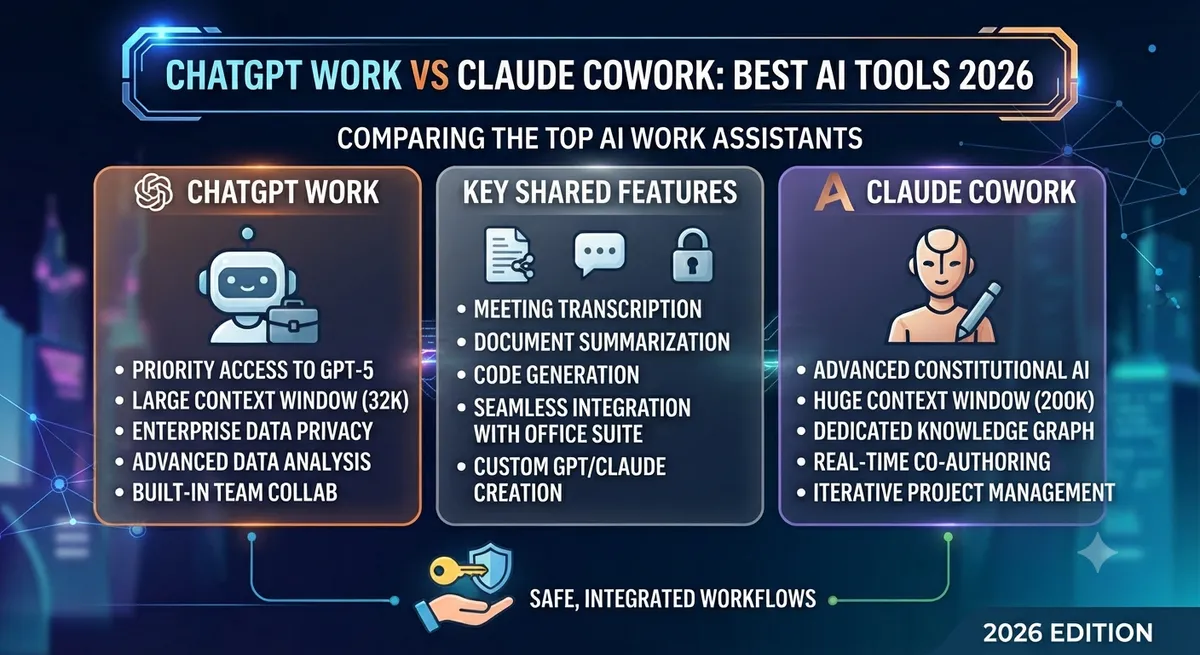
OpenAI just launched ChatGPT Work, a new AI agent aimed squarely at office workers who want the power of coding tools without needing to code — and it's a direct answer to Anthropic's Claude Cowork. If you're deciding which of these AI tools fits your team, here's what actually changed and how the two compare.

What Is ChatGPT Work?
ChatGPT Work combines OpenAI's chatbot with its AI coding tool, Codex, letting non-technical users create documents, presentations, and websites through natural conversation rather than writing code themselves. It's powered by OpenAI's newly launched model, GPT-5.6, which comes in three sizes — notably, the smallest version reportedly performs close to the largest one on many tasks, at a fraction of the cost. The rollout started with Pro, Enterprise, and Edu users, with Plus and Business access following shortly after.
Alongside ChatGPT Work, OpenAI also introduced a new desktop app and a hosted websites feature, letting users build and share simple websites directly through the assistant without separate hosting setup.
What Is Claude Cowork?
Claude Cowork, which Anthropic launched earlier this year, takes a similar approach: it's built for non-coders who want to tap into agentic AI capabilities — planning and executing multi-step tasks autonomously — without needing specialized technical knowledge. Both tools essentially aim to close the gap between "I have an idea" and "I have a working document, deck, or website," just from different underlying model families.
Why This Rivalry Is Heating Up Now
Both OpenAI and Anthropic are reportedly preparing for possible public offerings, and enterprise business — considered more lucrative than consumer subscriptions — is where this competition is concentrated. The launch of ChatGPT Work signals that OpenAI sees non-technical, white-collar workflows as a major growth area, competing not just with Anthropic but also with Microsoft's Copilot Cowork in the same space.
Which Should You Actually Use?
Since both tools solve a similar problem — giving non-coders access to agentic, coding-powered capabilities — the practical difference often comes down to which ecosystem you're already invested in, pricing tier access, and which assistant's output style you prefer for documents and presentations. If your team already uses ChatGPT daily, ChatGPT Work is a lower-friction upgrade path. If you're already on Claude for daily work, Cowork extends that investment naturally.
For a deeper look at how ChatGPT itself compares to alternatives beyond just this new agent, see our ChatGPT AI vs free AI tools comparison.

What This Means for Everyday Users (Not Just Enterprises)
While both tools initially target Pro, Enterprise, and Edu tiers, the broader trend is clear: AI tools that can autonomously handle multi-step tasks — not just answer a single question — are becoming the new competitive battleground, and that capability tends to trickle down to lower pricing tiers over time. If you're a small business or individual user, it's worth watching how quickly these agentic features reach more accessible plans.
Where These Tools Fit Alongside Specialist AI Tools
Even as general agentic assistants like ChatGPT Work and Claude Cowork get more capable, dedicated specialist tools still tend to outperform generalists on specific tasks. For content production specifically, our AI writing assistant category covers tools built purely around SEO structure and tone. For actual software development rather than document creation, the AI tools for developers directory covers dedicated coding assistants.
How to Decide for Your Team
Start by identifying the actual task volume: if your team frequently needs documents, decks, or simple websites built from a plain-language brief, an agentic tool like ChatGPT Work or Claude Cowork can meaningfully cut turnaround time. If your needs are narrower — just writing, just scheduling, just research — a specialist free or low-cost tool may get you there without the enterprise-tier commitment either of these agents currently requires. Browse the broader AI tools directory to compare agentic and specialist options side by side.
Frequently Asked Questions
Is ChatGPT Work free to use?
No, it launched first for Pro, Enterprise, and Edu users, with Plus and Business access rolling out shortly after — it is not currently part of ChatGPT's free tier.
What's the main difference between ChatGPT Work and Claude Cowork?
Both give non-coders access to agentic, coding-powered capabilities for creating documents and workflows, but they run on different underlying models and ecosystems, so output style and integration options differ.
Do I need coding experience to use either tool?
No, both are specifically designed for non-coders who want to leverage AI coding capabilities without writing code themselves.
Which tool is better for building a simple website?
ChatGPT Work includes a dedicated hosted websites feature alongside its document and presentation tools, making it a direct option for that specific task.
Final Thoughts
The ChatGPT Work vs Claude Cowork rivalry is really about who wins the enterprise agentic-AI market, but the ripple effects — better tools for non-coders — benefit everyday users too. Compare both alongside dozens of other AI tools in the full AI tools directory on AI List Stack.
Want to stay updated?
Get the latest AI tool reviews and news delivered to your inbox.