

Free AI Tools for Doctors: Best Picks for 2026
Physicians are adopting free AI tools faster than ever in 2026. Here are the strongest free options for documentation, research, and patient care.
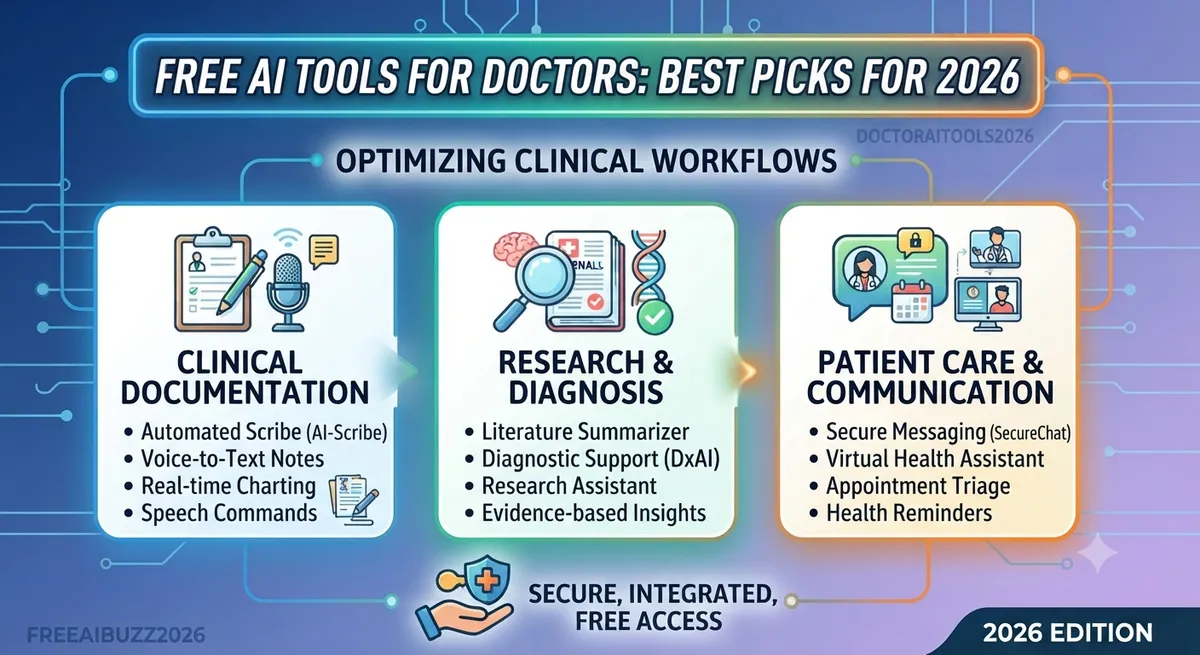
Between shrinking appointment times and rising documentation demands, it's no surprise physicians are turning to AI faster than almost any other profession. What's changed recently is how many of the strongest options are genuinely free AI tools for doctors — not stripped-down trial versions, but fully usable free tiers built specifically for clinical work.
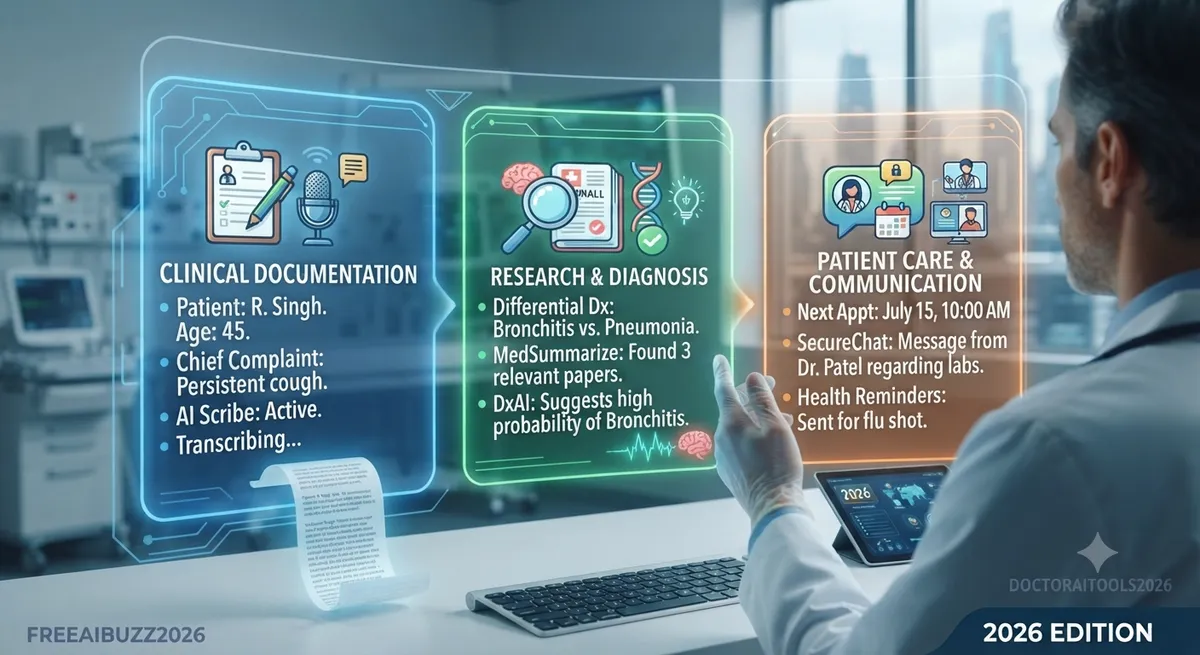
Free AI for Clinical Documentation
Ambient scribing tools — which listen to a patient encounter and generate structured clinical notes automatically — have become one of the biggest time-savers for physicians. Several platforms, including well-known names in this space, offer genuinely free tiers for verified clinicians, letting a solo practitioner evaluate ambient documentation without any upfront cost or long-term commitment. The time saved on notes is often the single biggest quality-of-life improvement doctors report after adopting one of these tools.
Free AI for Evidence-Based Clinical Research
Several platforms now offer free, evidence-grounded search over tens of millions of peer-reviewed papers, letting physicians ask plain-language clinical questions and get citation-backed answers in seconds instead of manually searching databases. Some of these platforms are free specifically because they're funded through pharmaceutical advertising rather than subscription fees — worth knowing when evaluating any "free" clinical tool's business model and potential bias.
Free AI for Practice Communication
Beyond documentation and research, several platforms offer free tiers for patient-facing communication — HIPAA-compliant calling, texting, and video consultation tools that keep a physician's personal number private while maintaining a professional record of patient interactions. For solo practitioners without a dedicated admin team, this alone can meaningfully reduce time spent on scheduling and follow-up calls.
What Makes a Free Clinical AI Tool Trustworthy
Not every "free" medical AI tool is safe to use with real patient data. Before adopting one, check for:
- HIPAA compliance (or your region's equivalent, like NHS-aligned standards in the UK), with a documented Business Associate Agreement where applicable
- Clear data handling policies — specifically whether patient data is retained, and for how long
- Verified professional access requirements — legitimate clinical tools typically require proof of licensure, which filters out consumer-facing lookalikes
- Transparent sourcing for any evidence-based answers, ideally with direct citations to peer-reviewed literature
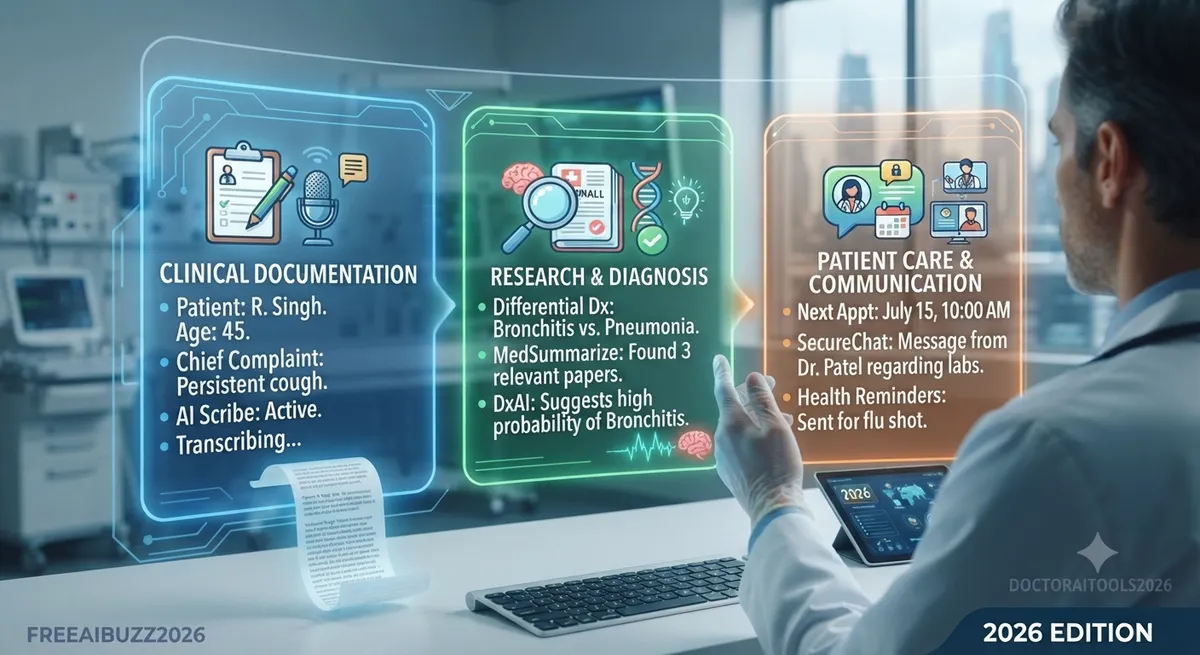
General AI Tools vs Purpose-Built Medical AI
General-purpose assistants like ChatGPT or Gemini can be genuinely useful for non-patient-specific tasks — drafting a general patient education handout, summarizing a public research topic, or preparing administrative communication. However, best practice strongly discourages entering real patient health information into general-purpose AI tools, since they typically aren't built with the same compliance infrastructure as purpose-built clinical platforms. For non-clinical administrative tasks, our ChatGPT alternatives guide and AI writing assistant category both cover general tools suitable for that kind of non-patient-specific drafting.
Building a Free Clinical AI Stack
Most physicians benefit from combining two or three free tools rather than relying on one all-in-one platform: one for ambient documentation, one for evidence-based research, and possibly one for patient communication. This mirrors a pattern common across every profession adopting AI in 2026 — see our broader AI productivity tools guide for how this "small stack" approach plays out in other fields.
A Note on Reviewing AI Output
Every reputable clinical AI tool is explicit that its output is meant to support, not replace, physician judgment — automated notes still need review, and evidence summaries should be checked against the underlying sources for anything affecting an actual treatment decision. Free tools are not exempt from this responsibility just because they cost nothing.
Frequently Asked Questions
Are free AI tools for doctors actually HIPAA-compliant?
Reputable clinical AI platforms built specifically for healthcare typically are, but always verify this directly with the vendor before entering any patient information — general-purpose consumer AI tools usually are not.
Is it safe to use general AI tools like ChatGPT for clinical notes?
Best practice is to avoid entering real patient health information into general-purpose AI tools and instead use platforms specifically built and verified for clinical use.
Do free clinical AI tools require professional verification?
Most legitimate ones do, requiring proof of medical licensure before granting access — this is actually a good trust signal rather than a barrier.
Can free AI tools fully replace a scribe or admin staff?
They significantly reduce the workload, but human oversight is still required to review and finalize AI-generated notes and communications.
Final Thoughts
Free clinical AI tools have matured well past the novelty stage in 2026 — documentation, research, and communication can all be meaningfully improved without a subscription, as long as HIPAA compliance and data handling are verified first. Explore adjacent free tools for non-clinical practice needs in the full AI tools directory on AI List Stack.
Want to stay updated?
Get the latest AI tool reviews and news delivered to your inbox.