

How AI Tools Saved My Small Business in 2026
A real small business owner shares how the best AI tools for small businesses in 2026 gave back time, eased burnout, and kept customers happy.
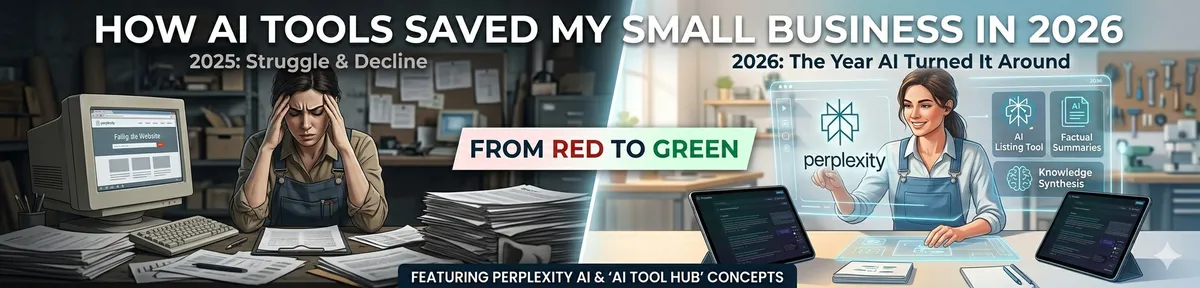
How AI Tools Saved My Small Business in 2026
Let me tell you where this started. A couple of years ago I was the kind of small business owner who wore every hat at once. I answered the emails, wrote the newsletters, posted on social media when I remembered to, chased down invoices, and somewhere in there tried to actually serve customers. By the end of most days I was exhausted and behind. If you run a small business, you know exactly the feeling I am describing. So when people talk about the best AI tools for small businesses 2026, I do not hear a tech trend. I hear the thing that gave me my evenings back.
I want to be honest up front: I was a skeptic. The first time someone told me an AI could write my marketing emails, I rolled my eyes. I had read enough robotic, soulless copy online to assume anything a machine wrote would embarrass me in front of my customers. I figured AI was for big companies with big budgets and dedicated tech teams, not for someone like me who still kept a paper notebook of customer orders. I was wrong about almost all of it, and figuring out why is the story I want to share.
This is not going to be a list of every tool on the market with feature comparisons and pricing tables. You can find those anywhere. Instead I want to walk you through how a real small business, with real time and money pressures, actually started using these tools, what worked, what flopped, and what I wish someone had told me before I wasted a few months figuring it out the hard way. Think of it as a conversation with a friend who went down this road a little ahead of you.
Because here is the thing nobody tells you: the hardest part of adopting AI is not the technology. The tools are easier to use than the software you already tolerate every day. The hard part is letting go of the belief that everything has to be done by you, by hand, to be done right. That belief nearly burned me out. Letting go of it, carefully and one task at a time, is what actually saved my business. Let me show you how.
Why This Matters in 2026
I think about a conversation I had with another shop owner last year. She was proud that she did everything herself, the way her parents had run their business. And I understood the pride completely. But I also watched her lose customers to a competitor who answered messages within seconds, day or night, while she got to inquiries whenever she could between serving the people physically in front of her. She was not losing because she worked less hard. She was losing because she was the only one working, and there are only so many hours in a day.
That is what changed in 2026, and why it matters so much for people like us. The tools that let a business be everywhere at once, responsive and polished and consistent, used to cost more than a small business could ever justify. Now they cost about what you spend on coffee for the month. The playing field did not just level. It tilted toward whoever is willing to learn a few new tools, regardless of how big their company is. That is genuinely new, and it is genuinely good news for the little guy.
I felt the shift personally the first month I let an AI handle my after-hours customer questions. I woke up to messages that had already been answered, accurately, in a tone that sounded like me, while I had been asleep. Customers thanked me for the fast response. I had done nothing. That morning I realized I had been confusing being busy with being effective, and that there was another way to run my business that did not require me to be exhausted all the time.
The reason this matters now and not later is simple. Your customers' expectations are already changing whether you participate or not. They are getting instant, personalized service from other businesses, and that becomes their new normal. If you are not part of that shift, you do not stay even. You slowly start to feel slow and old-fashioned to people, through no fault of your own effort. I did not want to find that out the hard way, and I do not want you to either.
The First Tool That Actually Worked
I want to start with the thing that flipped my skepticism, because it might be the easiest place for you to start too.
Letting Go of the Inbox
My email was a disaster. A shared inbox with hundreds of unread messages, the same questions over and over, important things buried under noise. I tried an AI assistant for it almost by accident. It started sorting my messages, summarizing the long rambling ones, and drafting replies to the common questions. At first I reviewed every single draft, suspicious. Then I noticed the drafts were good. Better than good, honestly, because the assistant was patient in a way I stopped being around message number forty. Within two weeks I trusted it enough that email went from two hours a day to twenty minutes.
The Moment It Clicked
The click moment was small. A customer wrote a frustrated message late at night. The assistant drafted a reply that was calm, kind, and helpful, the kind of reply I would have written on my best day but probably not at the end of a hard one. I sent it with one edit. The customer wrote back thrilled. I sat there realizing the tool had not replaced me. It had helped me show up as my best self even when I was running on empty. That reframing changed everything about how I saw these tools.
Building the Rest of the Stack
Once the inbox worked, I got braver. But I learned to add one thing at a time, because the one time I tried to adopt three tools at once I got overwhelmed and used none of them well.
Content Without the Dread
Writing marketing always filled me with dread. The blank page won most weeks. So I started using a writing assistant, but not the way I expected. I do not let it write for me. I talk to it. I tell it about a customer I helped or a product I am excited about, and it turns my rambling into a clean draft I then make sound like me again. The dread is gone. I publish consistently now, not because I became disciplined, but because the hard part got easy.
The Numbers I Used to Avoid
I am not a numbers person. The financial side of my business used to be a monthly source of anxiety. An AI bookkeeping tool changed that quietly. It sorts my transactions, flags weird ones, and lets me just ask questions like I am talking to an accountant friend. "How did last month compare to the one before?" and it tells me, plainly. For the first time I understand my own business finances, and understanding them made me a better owner.
What Went Wrong Along the Way
I do not want to make this sound like a fairy tale, because parts of it were frustrating and a couple of mistakes cost me.
The Time I Trusted Too Much
Early on, feeling confident, I let an AI-written description go out without reading it carefully. It contained a claim about a product that was not quite true. A customer caught it and was annoyed, fairly. That stung, and it taught me the rule I now never break: the AI drafts, I approve. Every time, before anything reaches a customer. It is fast and tireless but it is not always right, and treating it like a brilliant but occasionally careless assistant is exactly the right mental model.
The Shiny Object Problem
I also went through a phase of signing up for every new tool I read about, convinced the next one would be the magic one. I ended up paying for subscriptions I never opened and confusing myself with too many options. Eventually I cancelled most of them and kept the handful I actually used every day. Fewer, deeper, better. That is the lesson that took me longest to learn and saved me the most money once I did.
How to Get Started
If you take one thing from my story, let it be this: do not try to transform everything at once. Pick the single task that drains you most. For me it was email. For you it might be social media, or invoicing, or writing. Just one. Choose one tool aimed at that one thing and use it for a month, really use it, the way you would learn to drive somewhere new until it becomes automatic.
Pay attention to how it feels and what it saves you. Keep the human review step no matter what. If after a month you have your time back and your customers are happy, you will not need anyone to convince you to add the next tool, because you will want to. That craving to free up the next painful task is the right engine to grow your stack. Follow it slowly and you will build something that fits your business like it was made for it, because in a way you made it.
Common Mistakes to Avoid
The biggest mistake I made, and the one I see other owners make, is letting AI work reach a customer without a human glance. It feels safe right up until the day it is not. Keep yourself in the loop on anything customer-facing. It costs seconds and saves your reputation.
The second mistake is chasing every new tool. I get the temptation, I lived it. But a few tools you use deeply will always beat a pile you barely touch. Resist the shiny new thing unless it solves a problem you actually have right now.
The third mistake is being careless with customer information. I learned to check where my data goes before I paste anything sensitive into a tool. Your customers trust you with their details, and that trust has to extend to the tools you choose on their behalf.
The fourth mistake, and maybe the most human one, is automating a process that is already a mess. I tried to automate my chaotic scheduling once and just got chaos faster. Fix the underlying process first. Then let the tool make the good process effortless. And the last mistake is the one I almost made at the very beginning: deciding it is not for you before you have honestly tried it.
What I Wish Someone Had Told Me Earlier
Looking back on my whole journey with AI tools for small businesses, there are a handful of things I wish someone had just told me at the start, plainly, before I learned them the slow way. The first is that the awkward, clumsy early phase is completely normal and not a sign you are doing it wrong. Everyone goes through it. The tools feel strange, your first attempts are mediocre, and you wonder if the whole thing is overhyped. Push through that phase, because the good part is on the other side of it, and almost everyone who gives up does so before they get there.
The second thing I wish I had known is that it is okay to start embarrassingly small. I felt like I should be doing something impressive and ambitious right away, and that pressure nearly stopped me before I began. In truth, the small, almost trivial first step, the one that feels too modest to bother with, is exactly the right place to start. It builds the confidence and the understanding that everything else rests on, and there is no prize for skipping it. My best results all grew from a humble beginning I almost dismissed.
The third thing, and maybe the most freeing, is that you do not have to keep up with everything. I exhausted myself for a while trying to track every development in small business operations, every new option, every breathless announcement. It was not only impossible, it was counterproductive, because it kept me from going deep on the few things that actually mattered for my work. Letting go of the need to know it all was one of the most relieving and productive decisions I made.
The Mistakes I Keep Seeing Others Make
Now that I am a bit further along, I keep watching other people make the same mistakes I made, and I wish I could save them the trouble. The most common one is treating AI tools as either a miracle or a fraud, when the truth is squarely in between. The people who expect magic get disappointed and quit; the people who expect nothing never give it a real chance. The ones who do well hold a more honest middle view: genuinely powerful, genuinely imperfect, and worth learning properly.
Another mistake I see constantly is people refusing to change their habits to fit the new way of working. They bolt AI tools for small businesses onto exactly how they did things before and then wonder why it does not help much. The real gains come when you are willing to rethink the workflow itself, to let the new capability reshape how you approach small business operations rather than just speeding up the old approach a little. That willingness to change is uncomfortable, but it is where the transformation actually lives.
The Quiet Wins That Add Up
What surprised me most, in the end, was that the biggest payoff did not come from one dramatic breakthrough. It came from a lot of quiet, small wins that added up over time. A task that used to take an hour now takes ten minutes. A thing I used to dread is now painless. A capability I never had is now just available to me. None of these felt like a revolution on its own, but together, accumulating week after week, they genuinely changed the texture of my work and gave me back something I did not expect: a sense of ease.
Where I've Landed
After all the trial and error, the false starts and the lessons, I have settled into a relationship with AI tools for small businesses that feels stable and sane, and I want to describe it because I think it is achievable for most people. I am not chasing every new thing anymore. I have a focused set of approaches I understand well and trust, I keep a casual eye out for genuinely better options, and I spend most of my energy actually using what I have rather than constantly hunting for something else. That stability, after the early chaos, feels like a small victory in itself.
I have also made peace with the imperfections. Ai tools for small businesses still surprise me occasionally, sometimes by being better than I expected and sometimes by stumbling on something I assumed they would handle. I no longer find this frustrating. I have built in the habits, the checking, the judgment, the willingness to step in, that turn those imperfections from a problem into a manageable feature of working with a powerful but fallible capability. That acceptance is what lets me rely on them without being burned by them.
Most of all, I have stopped seeing this as a thing happening to me and started seeing it as a thing I am doing, deliberately, on my own terms. The narrative around AI tools for small businesses can make you feel swept along, like you are either riding a wave or being left behind by it. Reclaiming the sense that I am the one steering, choosing what to adopt, how to use it, and where to keep the human firmly in charge, changed everything about how the whole experience feels. It went from anxious to empowering.
What I'd Tell a Friend Starting Out
If a friend asked me how to begin with AI tools for small businesses today, I would not hand them a list of tools or a pile of articles. I would tell them to pick one small, real thing in small business operations that they actually want help with, try one option against it for a little while, and pay honest attention to how it feels and what it saves them. I would tell them to expect the awkward early phase and push through it, to keep themselves in charge of anything that matters, and not to worry about all the things they are not doing yet.
And I would tell them the thing it took me longest to believe: that this is genuinely within their reach, whoever they are. The hype can make AI tools for small businesses feel like the domain of experts and early adopters, but the truth I have lived is that an ordinary person, willing to learn a little and stay deliberate, can get enormous value from this. You do not need to be technical or ahead of the curve. You just need to start small, stay honest about what works, keep yourself at the center, and give it the patience that anything worthwhile requires. That is the whole secret, and it is one anyone can follow.
The Bigger Picture, In My Own Words
When I step back from all the specifics, what strikes me most about my whole experience with AI tools for small businesses is how much it changed not just my work but the way I feel about my work. I used to carry a low hum of being perpetually behind, of there always being more than I could get to. As I got comfortable with AI tools in small business operations, that hum quieted. Not because everything got done, it never does, but because I stopped having to do all of it myself, and that shift turned out to matter more for my peace of mind than I ever expected.
I also think there is something a little profound in learning to delegate to a capable tool, even beyond the time it saves. It forced me to get clearer about what I actually want, because you cannot hand off a task you cannot articulate. It made me distinguish the parts of my work that are genuinely mine, the judgment, the care, the relationships, from the parts that were just consuming me without needing me. That clarity was a gift hidden inside the practical benefit, and I did not see it coming.
If there is one thing I would want someone to take from my story, it is that you get to do this on your own terms. The noise around AI tools for small businesses can make you feel like you are being swept along by a current you did not choose. But I have found the opposite to be true once you engage deliberately. You choose what to adopt, how far to trust it, where to keep yourself firmly in charge, and what pace feels sustainable for you. The agency is yours the whole time, and reclaiming that feeling changes the entire experience from something stressful into something genuinely good.
So that is where I have landed, and where I hope you can land too: not breathless, not behind, not anxious about everything I am not doing, but steadily and contentedly getting real value from AI tools for small businesses in small business operations, on terms that fit my life. It took some stumbling to get here, and I would not pretend it was effortless. But it was worth it, and the door is open to anyone willing to start small, stay honest, and keep the human, you, at the center of it all.
Frequently Asked Questions
I am not technical at all. Can I really use these tools?
If I could, you can. I still keep a paper notebook for some things. The tools I use are operated by typing what I want in plain English, the same way I would ask a person. There was a learning curve of a few days, not weeks, and most tools walk you through setup. Do not let the word technology scare you off. These are the friendliest pieces of software I have ever used.
Will my customers feel like they are talking to a robot?
Honestly, not if you set it up with care and keep yourself involved. My customers regularly thank me for fast, warm responses that an AI helped draft and I approved. The key is that I review the tone and keep it sounding like me. When customers do hit the after-hours bot, a simple honest note that it is an assistant actually builds trust rather than breaking it.
How much did all this cost you?
Less than I expected and far less than what it saved. My whole stack costs about what a couple of streaming services would, and several tools I started with were free. The real return was not even the money. It was the hours of my life I got back, and the fact that I stopped dreading half the tasks in my week.
What if the AI makes a mistake?
It will, occasionally, which is exactly why I never let its work reach a customer without my approval. Think of it as a fast, capable assistant who is brilliant most of the time and careless once in a while. You would check that person's work, and you check the AI's the same way. With that habit in place, mistakes get caught before they matter.
Which tool should I start with?
Start with whatever drains you most. For me it was email, and an AI inbox assistant gave me the fastest, most obvious relief. For you it might be content or bookkeeping. The point is to pick the one painful thing, not to build a whole system on day one. Win once, feel the relief, and the rest follows naturally.
Did you have to let any employees go?
No, and that was never the point for me. What AI did was let my small team stop drowning in busywork so we could spend our time on customers and growth. It meant I did not have to hire for tasks I dreaded, not that I cut anyone. For most small businesses I know, it is about doing more without burning out, not about replacing people.
How long until it actually made a difference?
For me the first tool made a noticeable difference within two weeks, and a clear, undeniable one within a month. That is fast enough that you do not need faith to keep going; you will feel it. The slower part was learning the discipline of adding tools one at a time instead of all at once, which is more about patience than time.
Were you worried about your data and your customers' privacy?
Yes, and I still take it seriously. Before I trust a tool with anything sensitive I check how it handles data and whether it uses my information to train itself. There are good tools with clear, honest policies, and I stick to those. Treating your customers' data with the same care you treat their orders is just part of doing this right.
What would you tell someone who thinks AI is just hype?
I was that person. What changed my mind was not an article; it was one tool quietly giving me back two hours a day. So I would say: do not argue about whether it is hype. Just pick your most painful task, try one tool for a month, and let your own experience decide. That is the only argument that ever convinced me, and it is the only one that matters.
Conclusion
If you had told the exhausted, skeptical version of me from a couple of years ago that a few software tools would give me back my evenings, lower my stress, and make my customers happier all at once, I would not have believed you. But that is genuinely what happened, one careful step at a time. The tools did not run my business for me. They handled the repetitive parts so I could go back to the parts I actually started this business to do.
So if you are where I was, tired and behind and skeptical, I am not going to tell you to overhaul everything tomorrow. I am going to tell you to pick the one thing that drains you most and try one tool against it for a month. Keep yourself in the loop, protect your customers' trust, and resist the urge to chase every shiny new thing. Do that, and I think you will find what I found: not a robot takeover, just a little breathing room, and a business that finally feels like it fits inside a human life.
Want to stay updated?
Get the latest AI tool reviews and news delivered to your inbox.