

How I Made a Whole Video Without a Camera in 2026
A first-person story of making a whole video without a camera in 2026 using AI video tools like Veo 3, Kling AI, and Runway, the magic, the misfires, and the craft.
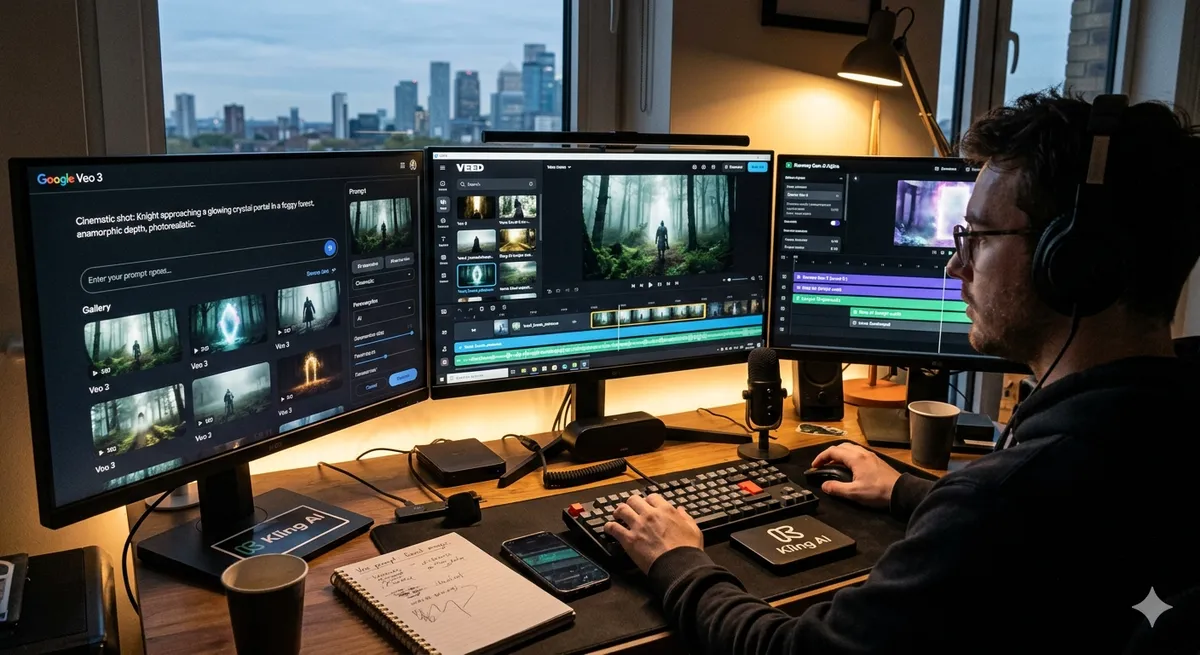
How I Made a Whole Video Without a Camera in 2026
I needed a short promotional video, the kind of thing that used to mean hiring someone, renting gear, and waiting two weeks. Instead, on a whim, I opened one of the new new AI tools generation tools 2026, typed a description of the shot I wanted, and a few minutes later watched footage appear that looked, genuinely, like it had been filmed. No camera. No crew. No location. Just a sentence and a little patience. I sat there a bit stunned, the same way I imagine people felt the first time a photograph developed in front of them.
I should say up front that I am not a filmmaker. I have always loved video as a medium but treated making it as something for other people, people with equipment and skills and budgets I did not have. That barrier felt permanent, like a wall between me and a whole way of communicating. So when I tell you that I made an entire usable video without any of those things, understand that for me it was not a tech demo. It was a door opening that I had assumed was locked for life.
But I do not want to oversell it either, because getting from that first stunned moment to an actual finished video I was proud of took more learning, more patience, and more humbling misfires than the breathless headlines suggest. The tools are remarkable and also still quirky. They nail some things and stumble on others. The first dozen generations were not the polished clip I eventually got. There is a craft to this, and I had to learn it the way you learn anything, by doing it badly for a while first.
So this is the honest story of how I actually made a video without a camera in 2026: the magic, the frustration, the tools I tried and why, the mistakes that cost me hours, and the moment it finally clicked. If you have ever wished you could just make the video in your head without becoming a filmmaker first, let me walk you through what it is really like now, because the answer turns out to be: more possible than ever, and more of a craft than you might expect.
Why This Matters in 2026
Here is why this hit me so hard. Video is everywhere now. It is how people learn things, how they decide what to buy, how they are entertained, how businesses present themselves. And for my whole adult life, I have been on the consuming side of that, never the making side, because making it was simply out of reach. So when the cost of producing decent video collapsed to a sentence and some iteration, it did not just give me a new tool. It let me participate in the dominant medium of the time in a way I never could before. That is bigger than a gadget.
What makes 2026 the year it happened, rather than the years before, is that the output finally got good enough to actually use. I had played with AI video earlier, and honestly it was a toy, mesmerizing but useless, all flicker and melt. The clips needed so much fixing that I would have been faster filming something real, if I could film at all. This year was different. The footage came out coherent, with believable motion and even matching sound. It crossed the line from something to marvel at into something I could put my name on.
I felt the practical weight of that immediately. The video I made would have cost real money and real weeks the old way. Instead it cost me an evening and a small fee. For someone like me, and for any small business or solo creator, that difference is not incremental, it is the difference between making the thing and not making it at all. Suddenly the kind of polished content that used to signal a big budget was within reach of anyone willing to learn, and that quietly changes who gets to be seen.
And yet the more powerful the tools felt, the more I found myself thinking about the heavier side of this. Technology that can conjure convincing video of basically anything is wonderful in my hands and frightening in the wrong ones. I caught myself reckoning with questions of consent and honesty, of not making footage of real people who never agreed to it, of not creating things designed to mislead. The power and the responsibility arrived together in my hands at the same moment, and I do not think you can use these tools seriously in 2026 without holding both.
The First Clip That Fooled Me
The thing that converted me from skeptic to believer was a single generation that looked real.
The Moment It Looked Filmed
I had described a fairly simple scene, nothing fancy, just a realistic shot with specific lighting and a bit of camera movement. When the result came back, the light fell the way I asked, the motion felt physical, and there was sound that matched. I actually leaned in to check whether I was looking at stock footage I had grabbed by accident. I was not. The tool had made it from my words. For realistic shots like that, the photorealistic tools, the ones everyone names as the leaders, genuinely delivered, and that first convincing clip is what made me believe the rest was worth learning.
When I Wanted a Different Look
Later I needed something that was not supposed to look real, a more stylized, animated feel for a different part of the project. The realistic tool was the wrong choice there, and I learned to reach for the ones built for expressive, stylized motion instead. That was my first real lesson: there is no single best tool, there is the right tool for the look you are going for, and learning which was which saved me a lot of fighting.
The Misfires That Taught Me the Craft
I do not want to pretend it was all magic, because the frustrating parts taught me the most.
Expecting Perfection on the First Try
My biggest early mistake was assuming the first generation would be the final video. It almost never was. I would type a prompt, get something close-but-wrong, and feel disappointed, as if the tool had failed me. Eventually I understood that this is iterative, that great results come from refining the prompt and generating again and again, getting more specific each time about the subject, the motion, the camera, the mood. Once I treated it as a craft of iteration rather than a vending machine, my results jumped dramatically.
Fighting the Tool's Weaknesses
The other hard lesson was learning what the tools are still bad at and stopping trying to force them. Long unbroken sequences, complicated scenes with several characters interacting, fiddly details like hands, those still tripped things up. I wasted hours fighting a tool on exactly the kind of shot it could not do well. The breakthrough was learning to generate the shots each tool nails, keep them short, and then stitch the good clips together in an ordinary editor. That hybrid way of working is what finally got me to a finished piece I was happy with.
How to Get Started
If you want to try this, and I really think you should, let me hand you the shortcuts I learned the slow way. Before you even pick a tool, get clear on what you are actually making. Realistic or stylized? Short clips or a longer piece? Speed or fine control? The right tool depends entirely on that, and choosing the goal first spared me a lot of the frustration of fighting a tool that was never built for my use case.
Then, please, go in expecting to iterate. The single biggest thing that improved my results was getting good at prompting, being specific about every element and generating several attempts rather than expecting the first to be the one. Budget time and a few generations for each shot. The people getting those jaw-dropping results are not luckier than you, they are just further along the craft of refining their prompts. Treat your first tries as practice, not failures.
And do not try to make one perfect clip do everything. The way I finally succeeded was generating short shots that each tool was great at, then assembling them into the full video in a regular editor, the same way a real production cuts footage together. Combining AI generation with plain old editing produced something far better than any single generation could. That hybrid workflow is the real secret, and it is how I went from stunned-at-one-clip to actually finishing the whole video without a camera.
Common Mistakes to Avoid
My first and most relatable mistake was getting hooked by the viral demos and assuming any tool would do that for me on any content. Those clips are cherry-picked. The right tool is the one suited to your specific kind of video, which you only discover by testing it on what you actually want to make, not by watching someone else's highlight reel.
The second mistake, the one that frustrated me most, was expecting a perfect result from a single prompt. This is iterative work. Refine, regenerate, get more specific. Giving up when the first try disappoints leaves almost all of the magic on the table, and I nearly quit before I learned that.
A third mistake I caught myself about to make was not reading the rules around who owns the footage and how I could use it. Before I put a generated clip into something public and commercial, I made myself check the tool's terms, because those vary and the consequences are real. Do not build a campaign on footage you have not confirmed you are allowed to use.
The fourth mistake is the heavy one: forgetting the ethics. It is so easy to generate convincing video of anything that you have to consciously decide not to make footage of real people without their consent or content meant to deceive. I hold that line firmly. And the last mistake is fighting a tool's weaknesses instead of working with its strengths, which just wastes your evening, where generating the shots it does well and editing them together gets you to a video you are actually proud of.
What I Wish Someone Had Told Me Earlier
Looking back on my whole journey with AI video generation tools, there are a handful of things I wish someone had just told me at the start, plainly, before I learned them the slow way. The first is that the awkward, clumsy early phase is completely normal and not a sign you are doing it wrong. Everyone goes through it. The tools feel strange, your first attempts are mediocre, and you wonder if the whole thing is overhyped. Push through that phase, because the good part is on the other side of it, and almost everyone who gives up does so before they get there.
The second thing I wish I had known is that it is okay to start embarrassingly small. I felt like I should be doing something impressive and ambitious right away, and that pressure nearly stopped me before I began. In truth, the small, almost trivial first step, the one that feels too modest to bother with, is exactly the right place to start. It builds the confidence and the understanding that everything else rests on, and there is no prize for skipping it. My best results all grew from a humble beginning I almost dismissed.
The third thing, and maybe the most freeing, is that you do not have to keep up with everything. I exhausted myself for a while trying to track every development in video creation and production, every new option, every breathless announcement. It was not only impossible, it was counterproductive, because it kept me from going deep on the few things that actually mattered for my work. Letting go of the need to know it all was one of the most relieving and productive decisions I made.
The Mistakes I Keep Seeing Others Make
Now that I am a bit further along, I keep watching other people make the same mistakes I made, and I wish I could save them the trouble. The most common one is treating AI video tools as either a miracle or a fraud, when the truth is squarely in between. The people who expect magic get disappointed and quit; the people who expect nothing never give it a real chance. The ones who do well hold a more honest middle view: genuinely powerful, genuinely imperfect, and worth learning properly.
Another mistake I see constantly is people refusing to change their habits to fit the new way of working. They bolt AI video generation tools onto exactly how they did things before and then wonder why it does not help much. The real gains come when you are willing to rethink the workflow itself, to let the new capability reshape how you approach video creation and production rather than just speeding up the old approach a little. That willingness to change is uncomfortable, but it is where the transformation actually lives.
The Quiet Wins That Add Up
What surprised me most, in the end, was that the biggest payoff did not come from one dramatic breakthrough. It came from a lot of quiet, small wins that added up over time. A task that used to take an hour now takes ten minutes. A thing I used to dread is now painless. A capability I never had is now just available to me. None of these felt like a revolution on its own, but together, accumulating week after week, they genuinely changed the texture of my work and gave me back something I did not expect: a sense of ease.
Where I've Landed
After all the trial and error, the false starts and the lessons, I have settled into a relationship with AI video generation tools that feels stable and sane, and I want to describe it because I think it is achievable for most people. I am not chasing every new thing anymore. I have a focused set of approaches I understand well and trust, I keep a casual eye out for genuinely better options, and I spend most of my energy actually using what I have rather than constantly hunting for something else. That stability, after the early chaos, feels like a small victory in itself.
I have also made peace with the imperfections. Ai video generation tools still surprise me occasionally, sometimes by being better than I expected and sometimes by stumbling on something I assumed they would handle. I no longer find this frustrating. I have built in the habits, the checking, the judgment, the willingness to step in, that turn those imperfections from a problem into a manageable feature of working with a powerful but fallible capability. That acceptance is what lets me rely on them without being burned by them.
Most of all, I have stopped seeing this as a thing happening to me and started seeing it as a thing I am doing, deliberately, on my own terms. The narrative around AI video generation tools can make you feel swept along, like you are either riding a wave or being left behind by it. Reclaiming the sense that I am the one steering, choosing what to adopt, how to use it, and where to keep the human firmly in charge, changed everything about how the whole experience feels. It went from anxious to empowering.
What I'd Tell a Friend Starting Out
If a friend asked me how to begin with AI video generation tools today, I would not hand them a list of tools or a pile of articles. I would tell them to pick one small, real thing in video creation and production that they actually want help with, try one option against it for a little while, and pay honest attention to how it feels and what it saves them. I would tell them to expect the awkward early phase and push through it, to keep themselves in charge of anything that matters, and not to worry about all the things they are not doing yet.
And I would tell them the thing it took me longest to believe: that this is genuinely within their reach, whoever they are. The hype can make AI video generation tools feel like the domain of experts and early adopters, but the truth I have lived is that an ordinary person, willing to learn a little and stay deliberate, can get enormous value from this. You do not need to be technical or ahead of the curve. You just need to start small, stay honest about what works, keep yourself at the center, and give it the patience that anything worthwhile requires. That is the whole secret, and it is one anyone can follow.
The Bigger Picture, In My Own Words
When I step back from all the specifics, what strikes me most about my whole experience with AI video generation tools is how much it changed not just my work but the way I feel about my work. I used to carry a low hum of being perpetually behind, of there always being more than I could get to. As I got comfortable with AI video tools in video creation and production, that hum quieted. Not because everything got done, it never does, but because I stopped having to do all of it myself, and that shift turned out to matter more for my peace of mind than I ever expected.
I also think there is something a little profound in learning to delegate to a capable tool, even beyond the time it saves. It forced me to get clearer about what I actually want, because you cannot hand off a task you cannot articulate. It made me distinguish the parts of my work that are genuinely mine, the judgment, the care, the relationships, from the parts that were just consuming me without needing me. That clarity was a gift hidden inside the practical benefit, and I did not see it coming.
If there is one thing I would want someone to take from my story, it is that you get to do this on your own terms. The noise around AI video generation tools can make you feel like you are being swept along by a current you did not choose. But I have found the opposite to be true once you engage deliberately. You choose what to adopt, how far to trust it, where to keep yourself firmly in charge, and what pace feels sustainable for you. The agency is yours the whole time, and reclaiming that feeling changes the entire experience from something stressful into something genuinely good.
So that is where I have landed, and where I hope you can land too: not breathless, not behind, not anxious about everything I am not doing, but steadily and contentedly getting real value from AI video generation tools in video creation and production, on terms that fit my life. It took some stumbling to get here, and I would not pretend it was effortless. But it was worth it, and the door is open to anyone willing to start small, stay honest, and keep the human, you, at the center of it all.
Frequently Asked Questions
Did you really make a usable video with no camera at all?
Yes, genuinely, and it still amazes me a little. I described the shots I wanted, generated them with AI video tools, refined them across several tries, and stitched the good ones together in a regular editor. No camera, no crew, no location. It took an evening and some patience rather than the weeks and budget the old way would have demanded, and the finished piece was something I was proud to share.
Which tools did you use?
I used different ones for different looks, which was a lesson in itself. For the realistic shots I leaned on the photorealistic leaders everyone names, like Veo 3. For the more stylized, animated parts I switched to tools built for expressive motion, like Kling AI. And for refining and assembling, control-focused tools like Runway helped. There is no single best one; I matched the tool to the look each part needed.
Was it actually good enough to look professional?
For short shots, honestly yes, to a degree that surprised me. The realistic footage had believable motion and even matching sound, good enough that I had to double-check it was not stock footage. It is not going to replace a big-budget film, especially for long continuous scenes, but for the kind of short promotional video I needed, it absolutely crossed the line into usable, professional-looking work.
How long did the whole thing take you?
The first stunned moment took minutes. The finished video took an evening, mostly because I was still learning to prompt well and had to iterate a lot. Each shot needed several attempts to get right, and then assembling them in an editor took a bit more time. Still, that is a fraction of the weeks the traditional route would have cost me, and most of the time was learning, which got faster.
Do you own the video you made?
I made a point of checking, and I would urge you to as well. Ownership and usage rights depend on each tool's terms, which genuinely vary, and the rules around AI-generated footage are still settling. Before I used any clip in something public, I read the licensing terms to be sure I was allowed to use it commercially. Do not skip that step the way it is tempting to.
What frustrated you most?
Expecting the first generation to be perfect, and it almost never was. I would get something close-but-wrong and feel let down, until I realized this is iterative craft, not a vending machine. Once I started refining my prompts and generating multiple attempts, getting specific about subject, motion, camera, and mood, my results improved dramatically. The frustration was really just me not yet understanding how the craft works.
What are the tools still bad at?
Long unbroken sequences, busy scenes with several characters interacting, and fiddly details like hands tripped them up for me. I wasted hours fighting a tool on shots it simply could not do well. The fix was to generate the shots each tool nails, keep them short, and assemble the good clips in an editor. Working with their strengths instead of against their weaknesses changed everything.
Were you worried about the ethics of it?
Yes, and I think anyone using these honestly should be. The same power that let me make my video could make convincing footage of real people who never agreed, or content meant to mislead. I hold a firm line: no footage of real people without consent, nothing deceptive. The technology handed me both the power and the responsibility at once, and I do not think you can take one without the other.
Would you make videos this way again?
Without hesitation. It opened a door I thought was locked for life, letting me make video without becoming a filmmaker first. I will keep using a mix of tools for different looks, keep treating it as an iterative craft, and keep assembling the good shots in an editor. For someone who always loved video but never had the gear or skills, this changed what I am able to create, and I am not going back.
Conclusion
Making a whole video without a camera in 2026 turned out to be both more magical and more of a craft than I expected. The first time a realistic clip appeared from nothing but my words, I was genuinely stunned, and that wonder was real. But getting from that moment to a finished piece I was proud of took learning to prompt, learning which tool fit which look, learning what the tools cannot do, and learning to stitch the good shots together in an editor. The magic got me started; the craft got me to the finish line.
So if you have ever wanted to make the video in your head but assumed it was out of reach, here is what my evening of trial and error taught me. Pick the tool that fits your goal, expect to iterate rather than nail it on the first try, work with each tool's strengths and edit the results together, and take the ownership and ethical questions seriously. Do that, and you will likely have the same experience I did: a door you thought was locked swinging open, and the slightly giddy realization that the dominant medium of our time is now something you, too, get to make.
Want to stay updated?
Get the latest AI tool reviews and news delivered to your inbox.