

I Tried Chasing Every New AI Tool. Here's What I Learned in 2026
A personal story of chasing every new AI tool in 2026, the burnout and wasted spend, and the simple habit of scanning, testing, and saying no that finally worked.
I Tried Chasing Every New AI Tool. Here's What I Learned in 2026
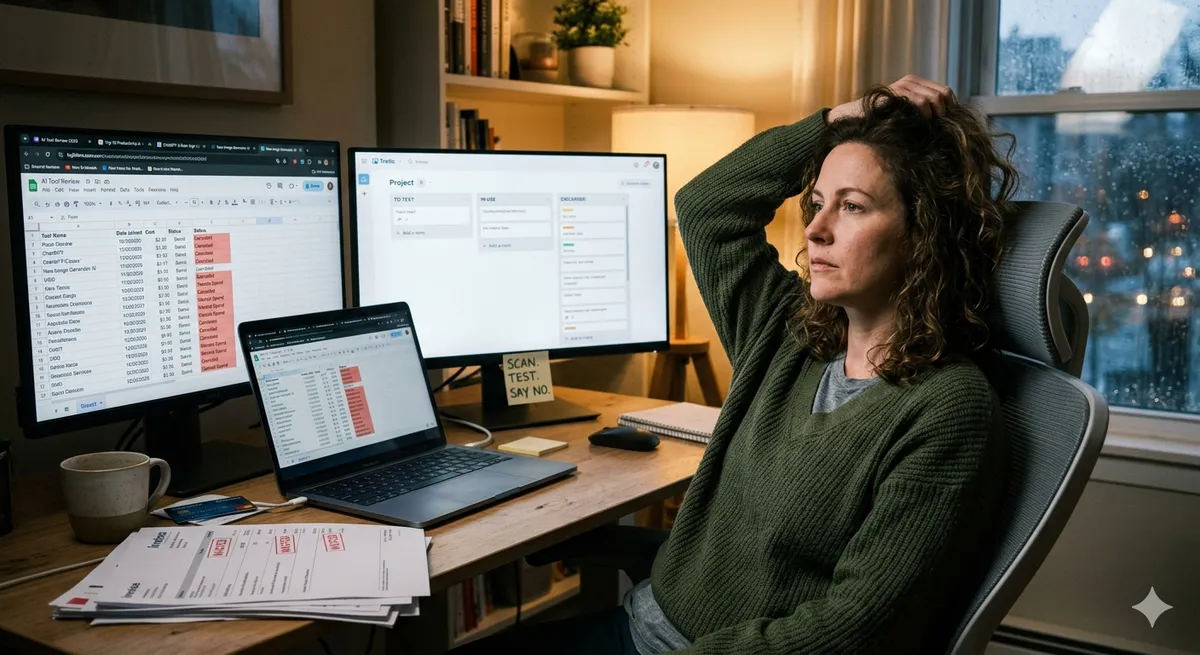
For a few months in 2026, I had a problem I am slightly embarrassed to admit. Every time I saw a new AI tool announced, and there are dozens every single month now, I signed up. I had to have it, try it, be on the cutting edge. My browser was a forest of tabs, my inbox a graveyard of welcome emails, my budget quietly bleeding from subscriptions I forgot I had. I was chasing every one of the new AI tools 2026 as if missing one would leave me hopelessly behind. It turned out I had the whole thing backward.
I think a lot of people feel the pull I felt. The pace of releases is genuinely dizzying, and there is a real fear of missing out baked into it. What if the tool I skip is the one that would have changed everything? What if everyone else adopts it and I am the last to know? That anxiety drove me to try to keep up with all of it, and for a while I wore my exhaustive tool collection like a badge of being in the know. I was not in the know. I was just overwhelmed and poorer.
The turning point came when I realized I could not actually name the last tool that had meaningfully improved my work, despite having tried what felt like a hundred. I had spread myself so thin across so many shiny new things that I had gone deep on none of them. I was collecting tools the way some people collect unread books, accumulating the promise of usefulness without ever extracting it. That was a humbling thing to admit, and it forced me to completely change how I relate to the endless stream of launches.
So this is the story of how I went from frantically chasing every release to calmly benefiting from the few that matter, and what that taught me about the real skill this era demands. Spoiler: the skill is not knowing every tool, which is impossible anyway. It is something quieter and much more valuable, and learning it gave me back my time, my budget, and oddly, the actual advantage I had been chasing in the first place. Let me tell you how it went.
Why This Matters in 2026
Here is what I eventually understood about why this matters so much right now. The pace of new tools is not slowing, it is accelerating, and that means the ground genuinely does shift under you constantly. This is real. I was not wrong that staying current matters. The gap between people who adopt useful new tools and people who do not really does widen month by month, and falling behind is a real risk in a world where the baseline of what is possible keeps rising. My instinct to keep up was sound. My method was a disaster.
What I had not appreciated was that the volume itself changes the game. In a slower time, you could plausibly try most of the important new things. Now you cannot, not even close, and pretending otherwise is how I ended up with a graveyard of subscriptions. The sheer abundance means the real challenge is not finding tools, there are endless tools, but choosing among them. The scarce thing is not the tools. It is the judgment to pick the right ones, and I had been spending all my energy on the abundant resource and none on the scarce one.
I also came to see, painfully, that the quality of releases is high enough that ignoring the stream entirely would be a mistake too. A meaningful number of these new tools are genuinely good, solving real problems in ways that were not possible before. So I could not just throw up my hands and tune it all out either. There were real gems in the flood, which meant the answer was never going to be ignore everything. It had to be a way to find the gems without drowning, which is exactly what I lacked.
And there was a quieter realization underneath all of it. When I did, occasionally and almost by accident, adopt a genuinely good new tool early, it gave me a real edge for a while, a faster way of working before everyone else caught on. That little advantage, I realized, could compound if I captured it deliberately month after month instead of randomly. The thing I had been chasing frantically, being ahead, was actually achievable, just not by the frantic method. It needed discernment, not frenzy, and that flipped my whole approach.
The Habit That Saved Me
What replaced my chaotic chasing was something almost boringly simple, and it changed everything.
A Small, Regular Window
Instead of reacting to every announcement the moment I saw it, I started setting aside one small, regular block of time to scan recent releases, but only in the few categories that actually relate to my work. Everything outside those categories, I let go of, guilt-free. That single change, bounding when and what I looked at, turned the firehose into something I could actually drink from. The fear of missing out faded once I trusted that my regular scan would catch anything genuinely relevant, and I stopped twitching at every notification.
Testing on Real Work, Not Demos
The other half of the habit was refusing to judge a tool by its launch hype. Burned too many times by polished demos that fell apart on my actual work, I started testing any promising tool on a real task I genuinely needed to do, using free trials. Within minutes I would know whether it delivered for me or just looked good in a video. That one discipline saved me from countless tools that demoed beautifully and helped not at all, and it made my keep-or-skip decisions honest.
Learning to Say No
The hardest and most freeing lesson was that the real skill is rejection, not collection.
Rejecting More Than I Kept
The mindset shift that finally fixed me was deciding that for every tool I kept, I should reject several. I had been doing the opposite, keeping nearly everything and committing to nothing. Once I gave myself permission, even an obligation, to say no to most of what I tried, my stack shrank to a focused handful of tools I actually used deeply. The relief was immediate. My budget recovered, my attention returned, and ironically my work improved, because I was finally going deep instead of spreading thin.
Resisting the Shiny New Thing
I also had to break my reflex of abandoning a working tool the second something newer appeared. I came to see that the disruption and relearning of switching usually cost more than the tiny improvement the new tool promised. So I started switching only when something was clearly, substantially better, not merely newer. Holding still with tools that worked, rather than churning constantly, turned out to be one of the most productive decisions I made, even though it felt counterintuitive to my chase-everything instincts.
How to Get Started
If you recognize yourself in my forest of tabs, let me hand you the way out that worked for me. Do not try to follow everything, because you cannot, and trying will only exhaust and impoverish you. Instead, pick the few categories of tools that actually relate to your work and set aside one small, regular window to scan just those. Let the rest go. The fear of missing out fades fast once you trust your routine to catch what matters.
When something looks promising, test it on a real task you genuinely do, with a free trial, before you believe a word of the marketing. A few minutes on real work tells you more than any demo. Judge each tool on whether it actually improves something you do, whether it fits the tools you already use, and whether it is worth the cost and the hassle of switching. That honest test is what separates the gems from the noise.
And please, learn to say no, because that is the real secret I missed for too long. Reject most of what you try. Keep only the tools that clearly earn their place, integrate them properly, and resist the constant itch to switch to whatever just launched. Aim for a small, focused stack of tools you use deeply, refreshed only occasionally when something is decisively better. Do that, and you get the advantage I was chasing all along, without the overwhelm I inflicted on myself getting there.
Common Mistakes to Avoid
My biggest mistake, the one this whole story is about, was chasing every release and collecting tools I never properly used. It spread me thin, drained my budget, and left me unable to name a single tool that had truly helped. Please do not collect. The skill is discernment, not accumulation, and I learned that the expensive way.
The second mistake I made constantly was trusting launch hype and slick demos instead of testing for myself. New tools are sold at their absolute best, and the demo tells you almost nothing about whether it will help you. Test every promising tool on a real task before believing the claims. That single habit would have saved me months of disappointment.
A third mistake was my reflex to switch tools the instant something newer appeared. The relearning and disruption almost always cost more than the small gain. I learned to switch only when a tool was clearly and substantially better, not just shinier and more recent. Holding still with what works is underrated.
The fourth mistake was ignoring whether a tool fit my existing setup, adopting things that created friction at every handoff. A slightly less impressive tool that slots into your workflow beats a flashier one that does not, so weigh that fit heavily. And the last mistake, which I am careful about now, is not giving agentic tools extra scrutiny. Because agents actually act rather than just answer, I test their reliability and safety far more carefully before trusting them with real work.
What I Wish Someone Had Told Me Earlier
Looking back on my whole journey with new AI tools, there are a handful of things I wish someone had just told me at the start, plainly, before I learned them the slow way. The first is that the awkward, clumsy early phase is completely normal and not a sign you are doing it wrong. Everyone goes through it. The tools feel strange, your first attempts are mediocre, and you wonder if the whole thing is overhyped. Push through that phase, because the good part is on the other side of it, and almost everyone who gives up does so before they get there.
The second thing I wish I had known is that it is okay to start embarrassingly small. I felt like I should be doing something impressive and ambitious right away, and that pressure nearly stopped me before I began. In truth, the small, almost trivial first step, the one that feels too modest to bother with, is exactly the right place to start. It builds the confidence and the understanding that everything else rests on, and there is no prize for skipping it. My best results all grew from a humble beginning I almost dismissed.
The third thing, and maybe the most freeing, is that you do not have to keep up with everything. I exhausted myself for a while trying to track every development in evaluating a constant stream of launches, every new option, every breathless announcement. It was not only impossible, it was counterproductive, because it kept me from going deep on the few things that actually mattered for my work. Letting go of the need to know it all was one of the most relieving and productive decisions I made.
The Mistakes I Keep Seeing Others Make
Now that I am a bit further along, I keep watching other people make the same mistakes I made, and I wish I could save them the trouble. The most common one is treating new tools as either a miracle or a fraud, when the truth is squarely in between. The people who expect magic get disappointed and quit; the people who expect nothing never give it a real chance. The ones who do well hold a more honest middle view: genuinely powerful, genuinely imperfect, and worth learning properly.
Another mistake I see constantly is people refusing to change their habits to fit the new way of working. They bolt new AI tools onto exactly how they did things before and then wonder why it does not help much. The real gains come when you are willing to rethink the workflow itself, to let the new capability reshape how you approach evaluating a constant stream of launches rather than just speeding up the old approach a little. That willingness to change is uncomfortable, but it is where the transformation actually lives.
The Quiet Wins That Add Up
What surprised me most, in the end, was that the biggest payoff did not come from one dramatic breakthrough. It came from a lot of quiet, small wins that added up over time. A task that used to take an hour now takes ten minutes. A thing I used to dread is now painless. A capability I never had is now just available to me. None of these felt like a revolution on its own, but together, accumulating week after week, they genuinely changed the texture of my work and gave me back something I did not expect: a sense of ease.
Where I've Landed
After all the trial and error, the false starts and the lessons, I have settled into a relationship with new AI tools that feels stable and sane, and I want to describe it because I think it is achievable for most people. I am not chasing every new thing anymore. I have a focused set of approaches I understand well and trust, I keep a casual eye out for genuinely better options, and I spend most of my energy actually using what I have rather than constantly hunting for something else. That stability, after the early chaos, feels like a small victory in itself.
I have also made peace with the imperfections. New ai tools still surprise me occasionally, sometimes by being better than I expected and sometimes by stumbling on something I assumed they would handle. I no longer find this frustrating. I have built in the habits, the checking, the judgment, the willingness to step in, that turn those imperfections from a problem into a manageable feature of working with a powerful but fallible capability. That acceptance is what lets me rely on them without being burned by them.
Most of all, I have stopped seeing this as a thing happening to me and started seeing it as a thing I am doing, deliberately, on my own terms. The narrative around new AI tools can make you feel swept along, like you are either riding a wave or being left behind by it. Reclaiming the sense that I am the one steering, choosing what to adopt, how to use it, and where to keep the human firmly in charge, changed everything about how the whole experience feels. It went from anxious to empowering.
What I'd Tell a Friend Starting Out
If a friend asked me how to begin with new AI tools today, I would not hand them a list of tools or a pile of articles. I would tell them to pick one small, real thing in evaluating a constant stream of launches that they actually want help with, try one option against it for a little while, and pay honest attention to how it feels and what it saves them. I would tell them to expect the awkward early phase and push through it, to keep themselves in charge of anything that matters, and not to worry about all the things they are not doing yet.
And I would tell them the thing it took me longest to believe: that this is genuinely within their reach, whoever they are. The hype can make new AI tools feel like the domain of experts and early adopters, but the truth I have lived is that an ordinary person, willing to learn a little and stay deliberate, can get enormous value from this. You do not need to be technical or ahead of the curve. You just need to start small, stay honest about what works, keep yourself at the center, and give it the patience that anything worthwhile requires. That is the whole secret, and it is one anyone can follow.
The Bigger Picture, In My Own Words
When I step back from all the specifics, what strikes me most about my whole experience with new AI tools is how much it changed not just my work but the way I feel about my work. I used to carry a low hum of being perpetually behind, of there always being more than I could get to. As I got comfortable with new tools in evaluating a constant stream of launches, that hum quieted. Not because everything got done, it never does, but because I stopped having to do all of it myself, and that shift turned out to matter more for my peace of mind than I ever expected.
I also think there is something a little profound in learning to delegate to a capable tool, even beyond the time it saves. It forced me to get clearer about what I actually want, because you cannot hand off a task you cannot articulate. It made me distinguish the parts of my work that are genuinely mine, the judgment, the care, the relationships, from the parts that were just consuming me without needing me. That clarity was a gift hidden inside the practical benefit, and I did not see it coming.
If there is one thing I would want someone to take from my story, it is that you get to do this on your own terms. The noise around new AI tools can make you feel like you are being swept along by a current you did not choose. But I have found the opposite to be true once you engage deliberately. You choose what to adopt, how far to trust it, where to keep yourself firmly in charge, and what pace feels sustainable for you. The agency is yours the whole time, and reclaiming that feeling changes the entire experience from something stressful into something genuinely good.
So that is where I have landed, and where I hope you can land too: not breathless, not behind, not anxious about everything I am not doing, but steadily and contentedly getting real value from new AI tools in evaluating a constant stream of launches, on terms that fit my life. It took some stumbling to get here, and I would not pretend it was effortless. But it was worth it, and the door is open to anyone willing to start small, stay honest, and keep the human, you, at the center of it all.
Frequently Asked Questions
How do you keep up with new AI tools now without burning out?
I stopped trying to follow everything, which was the whole problem. Now I set aside one small, regular window to scan only the few categories relevant to my work, and I let the rest go. I trust that routine to catch anything genuinely important. Bounding when and what I look at turned the overwhelming firehose into something manageable, and honestly it gave me my time and sanity back.
Did chasing every tool actually hurt you?
Yes, more than I realized at the time. It drained my budget on subscriptions I forgot I had, scattered my attention so I went deep on nothing, and left me unable to name a single tool that had truly improved my work despite trying dozens. The chasing felt productive, like staying ahead, but it was the opposite. It was busy, expensive, and ultimately useless until I changed my approach.
How do you tell a genuinely useful tool from hype now?
I test it on a real task I actually need to do, using a free trial, before I trust any of the marketing. Within minutes I can tell whether it delivers for me or just shone in a demo video. I got burned enough times by polished launches that fell apart on real work that this became non-negotiable. Real testing on real work is the only test I trust anymore.
What finally fixed your tool-chasing habit?
Deciding that for every tool I keep, I should reject several. I had been doing the reverse, keeping almost everything. Once I gave myself permission to say no to most of what I tried, my stack shrank to a focused handful I actually used deeply, my budget recovered, and my work got better. Learning to reject, rather than collect, was the single change that turned everything around.
Should I switch to a new tool every time a better one launches?
No, and breaking that reflex was one of my best decisions. The disruption and relearning of switching almost always cost more than the small improvement a newer tool promised. I now switch only when something is clearly and substantially better, not merely newer. Holding still with tools that work, rather than constantly churning, turned out to be far more productive than my old chase-the-shiny-thing instinct.
How many AI tools do you actually use now?
Far fewer than I used to sign up for, and that is the point. A focused handful that I use deeply and that fit together, rather than the sprawling collection I once accumulated. For every tool I keep, I reject several, and I only refresh the stack occasionally when something is decisively better. The small, deliberate set serves me far better than the graveyard of half-used subscriptions ever did.
Do you still worry about missing an important tool?
Much less than I used to, because I trust my regular scan of the relevant categories to surface anything that genuinely matters. The fear of missing out was loudest when I had no system and felt I had to catch everything in real time. Once I had a routine I trusted, the anxiety faded. And honestly, if I am a little late to a truly important tool, my testing habit lets me adopt it quickly anyway.
Do you treat AI agents differently from other new tools?
Yes, much more carefully. Because agents actually take actions rather than just answer questions, a mistake from one can do real damage, not just give a bad answer. So when I evaluate a new agent, I test its reliability on my real work far more thoroughly and pay close attention to safety and guardrails before trusting it with anything that matters. The upside is big, but so is the need for caution.
Was being an early adopter ever actually worth it?
When I did it deliberately rather than frantically, yes. The few times I adopted a genuinely good new tool early, it gave me a real edge for a while before everyone caught on. The realization was that this advantage compounds if you capture it through discernment, month after month, rather than chasing everything randomly. The edge I was after was real; I just had to stop chasing it the wrong way to actually get it.
Conclusion
I spent a few months in 2026 frantically chasing every new AI tool, and all it got me was a forest of dead browser tabs, a drained budget, and the strange inability to name anything that had actually helped me. The hard lesson was that in a market this fast, trying to follow everything is not staying ahead, it is just spreading yourself too thin to benefit from anything. The volume of releases had quietly changed the game, and I had been playing the old one.
What saved me was almost embarrassingly simple: a small regular window to scan only my relevant categories, a habit of testing promising tools on real work instead of trusting demos, and above all the discipline to reject far more than I keep. Once I learned to say no, my stack shrank to a focused handful I actually use, and the advantage I had been chasing showed up on its own. So if you are lost in the flood like I was, stop chasing. Build the quiet habit instead. The skill that matters in 2026 was never knowing every tool. It was the judgment to choose the few that count, and that judgment, unlike the tools, is yours to keep.
Want to stay updated?
Get the latest AI tool reviews and news delivered to your inbox.