

I Watched AI Go From Talking to Doing, and Suddenly Everything Changed
A first-person account of watching AI go from talking to doing in 2026, why that shift made AI agents the biggest trend, and how to engage with awe and caution.
I Watched AI Go From Talking to Doing, and Suddenly Everything Changed
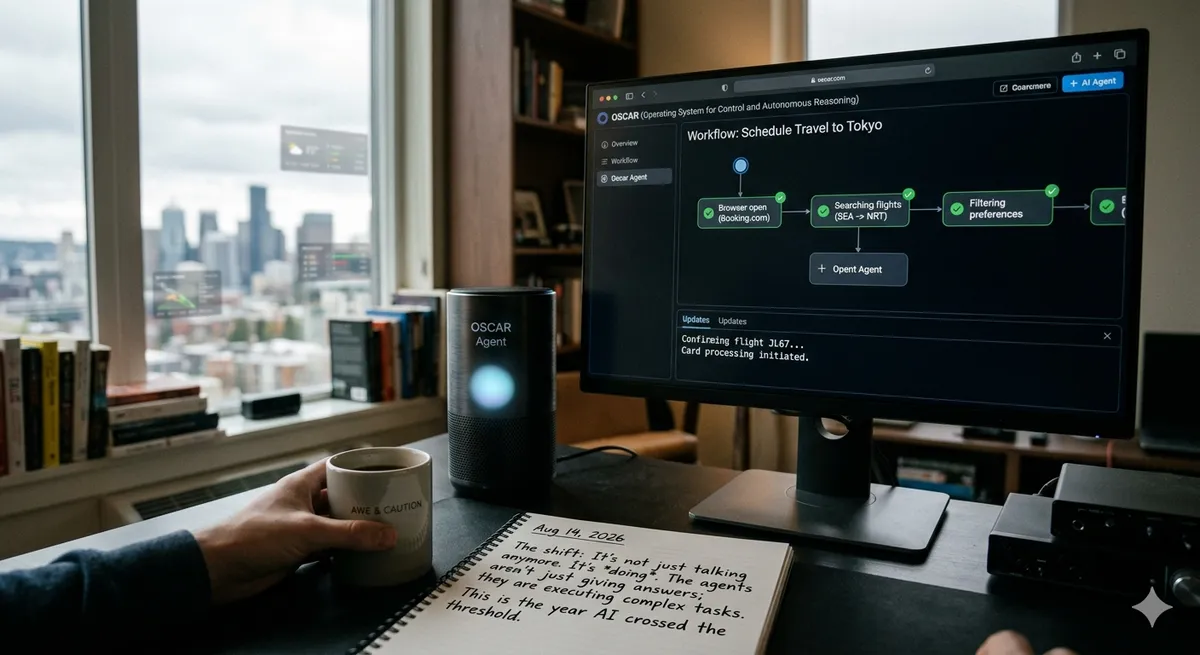
For years I used AI the way most people did: I asked it things, it answered, and that was that. It was a clever conversationalist, a tireless writer, an endless source of explanations. Genuinely useful, but always one step removed from the actual work, because after it gave me its brilliant output, I still had to go and do something with it. Then, sometime in 2026, that quietly stopped being true, and watching it change is the best way I can explain why AI agents 2026 became the only thing anyone in technology seemed to want to talk about. The AI stopped just talking. It started doing.
I remember the shift not as a single dramatic moment but as a slow dawning. I would give the AI a goal instead of a question, and instead of telling me how I might accomplish it, it would just go and accomplish it, planning the steps, using the tools, handling the parts I would normally have done myself, and handing me back not advice but a finished result. The first few times, I kept waiting for the catch, for the moment where I had to take over. The moment did not come. The work was done. That, I realized, was something entirely new.
And once I felt that shift, the wall-to-wall hype about agents suddenly made sense to me in a way the headlines never had. I had been a little cynical about it, honestly, assuming it was the usual breathless overselling of whatever was new. But living through the change from AI-that-talks to AI-that-acts, I understood why everyone was losing their minds. It was not just another incremental improvement to marvel at and forget. It was a genuine change in what software is for, the kind of shift that comes along rarely and reshapes everything around it.
So this is my attempt to explain, from the inside of actually experiencing it, why agents became the defining trend of the year, and why I think it deserves the attention even as the hype occasionally goes overboard. It is part awe and part caution, because I have also seen the gap between what agents are breathlessly promised to do and what they actually, reliably do today. Let me tell you what it felt like to watch AI cross the line from talking to doing, and why that crossing changed how I think about work itself.
Why This Matters in 2026
Here is why I think this matters far beyond the hype cycle: when AI stopped just talking and started doing, it changed what I could delegate, and changing what you can delegate changes everything about how you work. Before, AI could advise me on a task but I still had to execute it. Now it executes. That sounds like a small distinction until you live it, and then you realize the whole bottleneck of getting things done has moved. It is no longer about how fast I can do the work. It is about how well I can hand the work off and check it.
What convinced me the trend was real substance and not just noise was precisely that it reflected something I could feel working, not just something I read about. A lot of technology hype is exactly that, hype, excitement with nothing underneath. But this was different. Underneath all the breathless headlines was an AI that genuinely took goals and finished multi-step work for me, reliably enough that I started trusting it with real things. The trend was huge because the reality underneath it was huge, and feeling that reality firsthand is what turned me from a skeptic into a believer.
I also came to feel a quiet urgency about understanding it correctly, because I watched people around me split into two camps that both seemed to be getting it wrong. Some dismissed the whole thing as overblown nonsense and kept doing everything by hand, falling behind as the rest of us delegated. Others believed every wild claim and bet heavily on agents doing things they could not yet reliably do, and got burned. I did not want to be in either camp. I wanted to see clearly: the real shift and the overhyped froth, and position myself accordingly.
And the deepest reason it matters, to me, is that this feels less like a passing fashion and more like a glimpse of where everything is going. The move from AI that talks to AI that acts is a direction, not a moment, and the momentum behind it, all the attention and money and talent pouring in, only seems to be accelerating. Watching it unfold, I got the strong sense that I was not looking at this year's fad but at the early shape of how work and software will function from here on. Reading that shift clearly felt like reading the future.
The Moment It Stopped Just Talking
The shift that started everything, for me, was the leap from output to action.
From Answers to Finished Work
The thing that broke my old mental model was giving the AI a goal and getting back not an answer but a completed job. It planned the steps itself, reached for the tools it needed, did the work across all of them, and handed me a result to review rather than instructions to follow. I had spent years thinking of AI as something that produced output I then had to use. Suddenly it was something that simply did the thing, and that single shift, from generating to doing, is the whole reason the trend exploded. It changed AI from an advisor into a worker.
The Reliability That Made Me Trust It
What made me actually rely on it, rather than just be impressed once, was that it became dependable. I had seen agent-like demos before that fell apart the moment you trusted them with anything real. This was different. For the well-defined work I gave it, it just kept getting the job done, reliably enough that I stopped double-checking every single thing and started genuinely delegating. That reliability, more than any flashy capability, is what turned the idea of agents from a perennial promise into something I actually used, and use is what creates a real trend.
Why Everyone Suddenly Cared
Once I felt the shift myself, the universal obsession with agents made complete sense.
It Was About Doing More Without More People
The reason businesses everywhere went agent-crazy clicked for me when I noticed how much I personally was getting done. An agent did not just speed up one step of my work; it took whole tasks off my plate entirely. I could direct several of them and accomplish what used to take far more effort. Scale that across a company and the appeal is obvious: do dramatically more with the same people. That economic pull, the sheer productivity of it, is the engine I think drove so much of the frenzy and the money chasing the trend.
It Felt Like a New Way of Working
But it was not only economics. There was something that genuinely captured my imagination, and clearly everyone else's, about the change in relationship. For my whole life, using software meant operating it, telling it every step. Now I was directing it toward goals and it figured out the how, more like a colleague than a tool. That reframing, software as something you delegate to rather than something you operate, was exciting in a way no mere feature ever is. Big trends form around shifts that change how we imagine working, and this was exactly that kind of shift.
How to Get Started
If you are watching the agent frenzy and not sure what to make of it, here is what worked for me. Do not just consume the headlines, because the headlines are where the froth lives. Instead, go and actually feel the shift yourself by giving an agent a real, contained task and watching what it does. Nothing I read convinced me the way one experience of handing over a goal and getting back finished work did. The hands-on feeling cuts through both the cynicism and the hype far better than any article, including this one.
As you do that, work on the skill I realized matters most now: directing and supervising agents well. The bottleneck has moved from doing the work to delegating it and checking it, so that is the muscle worth building. Start with low-stakes tasks you can easily verify, learn what the agents reliably handle and where they still stumble, and develop your instinct for what to hand off and how closely to watch. That practical understanding is worth more than tracking every announcement, and it is what positions you to actually benefit as the trend deepens.
Above all, try to do what I tried to do: hold the awe and the caution together. The real shift, AI that acts instead of just talking, is genuine and here to stay, so it is worth taking seriously and building around. But the most extravagant claims, the ones promising agents that do absolutely everything autonomously today, do not all hold up, so verify before you bet heavily on them. Embracing the real change while keeping a clear eye on the overhyped parts is, I think, the only sane way to engage with something this big and this noisy at once.
Common Mistakes to Avoid
The first mistake I watched people make, and nearly made myself, was dismissing the whole agent thing as pure hype. The hype is real, sure, but writing off the entire trend means missing a genuine shift in what software can do. I almost did this out of reflexive cynicism, and I would have missed something that actually changed how I work.
The opposite mistake, which I saw burn people, was believing every wild claim and assuming agents could already do everything autonomously. The reality is more bounded than the loudest promises suggest. Engage with the trend, absolutely, but verify what agents can actually do on your real work rather than trusting the breathless version.
A third mistake is treating it as a fad to wait out. I do not think it is. The move from talking to doing is a direction of travel, and the momentum behind it kept building the whole time I watched. Waiting for it to blow over struck me as a quiet way of falling behind while it deepens.
The fourth mistake is just reading about it instead of feeling it. The headlines gave me the froth; one real experience of delegating to an agent gave me the substance. And the last mistake, the one I am most careful to avoid now, is not building the skill the trend rewards, learning to direct and supervise agents well, because that, more than anything, is what separates the people who benefit from this shift from the people who only watch it happen.
What I Wish Someone Had Told Me Earlier
Looking back on my whole journey with AI agents, there are a handful of things I wish someone had just told me at the start, plainly, before I learned them the slow way. The first is that the awkward, clumsy early phase is completely normal and not a sign you are doing it wrong. Everyone goes through it. The tools feel strange, your first attempts are mediocre, and you wonder if the whole thing is overhyped. Push through that phase, because the good part is on the other side of it, and almost everyone who gives up does so before they get there.
The second thing I wish I had known is that it is okay to start embarrassingly small. I felt like I should be doing something impressive and ambitious right away, and that pressure nearly stopped me before I began. In truth, the small, almost trivial first step, the one that feels too modest to bother with, is exactly the right place to start. It builds the confidence and the understanding that everything else rests on, and there is no prize for skipping it. My best results all grew from a humble beginning I almost dismissed.
The third thing, and maybe the most freeing, is that you do not have to keep up with everything. I exhausted myself for a while trying to track every development in the defining shift in what software can do, every new option, every breathless announcement. It was not only impossible, it was counterproductive, because it kept me from going deep on the few things that actually mattered for my work. Letting go of the need to know it all was one of the most relieving and productive decisions I made.
The Mistakes I Keep Seeing Others Make
Now that I am a bit further along, I keep watching other people make the same mistakes I made, and I wish I could save them the trouble. The most common one is treating AI agents as either a miracle or a fraud, when the truth is squarely in between. The people who expect magic get disappointed and quit; the people who expect nothing never give it a real chance. The ones who do well hold a more honest middle view: genuinely powerful, genuinely imperfect, and worth learning properly.
Another mistake I see constantly is people refusing to change their habits to fit the new way of working. They bolt AI agents onto exactly how they did things before and then wonder why it does not help much. The real gains come when you are willing to rethink the workflow itself, to let the new capability reshape how you approach the defining shift in what software can do rather than just speeding up the old approach a little. That willingness to change is uncomfortable, but it is where the transformation actually lives.
The Quiet Wins That Add Up
What surprised me most, in the end, was that the biggest payoff did not come from one dramatic breakthrough. It came from a lot of quiet, small wins that added up over time. A task that used to take an hour now takes ten minutes. A thing I used to dread is now painless. A capability I never had is now just available to me. None of these felt like a revolution on its own, but together, accumulating week after week, they genuinely changed the texture of my work and gave me back something I did not expect: a sense of ease.
Where I've Landed
After all the trial and error, the false starts and the lessons, I have settled into a relationship with AI agents that feels stable and sane, and I want to describe it because I think it is achievable for most people. I am not chasing every new thing anymore. I have a focused set of approaches I understand well and trust, I keep a casual eye out for genuinely better options, and I spend most of my energy actually using what I have rather than constantly hunting for something else. That stability, after the early chaos, feels like a small victory in itself.
I have also made peace with the imperfections. Ai agents still surprise me occasionally, sometimes by being better than I expected and sometimes by stumbling on something I assumed they would handle. I no longer find this frustrating. I have built in the habits, the checking, the judgment, the willingness to step in, that turn those imperfections from a problem into a manageable feature of working with a powerful but fallible capability. That acceptance is what lets me rely on them without being burned by them.
Most of all, I have stopped seeing this as a thing happening to me and started seeing it as a thing I am doing, deliberately, on my own terms. The narrative around AI agents can make you feel swept along, like you are either riding a wave or being left behind by it. Reclaiming the sense that I am the one steering, choosing what to adopt, how to use it, and where to keep the human firmly in charge, changed everything about how the whole experience feels. It went from anxious to empowering.
What I'd Tell a Friend Starting Out
If a friend asked me how to begin with AI agents today, I would not hand them a list of tools or a pile of articles. I would tell them to pick one small, real thing in the defining shift in what software can do that they actually want help with, try one option against it for a little while, and pay honest attention to how it feels and what it saves them. I would tell them to expect the awkward early phase and push through it, to keep themselves in charge of anything that matters, and not to worry about all the things they are not doing yet.
And I would tell them the thing it took me longest to believe: that this is genuinely within their reach, whoever they are. The hype can make AI agents feel like the domain of experts and early adopters, but the truth I have lived is that an ordinary person, willing to learn a little and stay deliberate, can get enormous value from this. You do not need to be technical or ahead of the curve. You just need to start small, stay honest about what works, keep yourself at the center, and give it the patience that anything worthwhile requires. That is the whole secret, and it is one anyone can follow.
The Bigger Picture, In My Own Words
When I step back from all the specifics, what strikes me most about my whole experience with AI agents is how much it changed not just my work but the way I feel about my work. I used to carry a low hum of being perpetually behind, of there always being more than I could get to. As I got comfortable with AI agents in the defining shift in what software can do, that hum quieted. Not because everything got done, it never does, but because I stopped having to do all of it myself, and that shift turned out to matter more for my peace of mind than I ever expected.
I also think there is something a little profound in learning to delegate to a capable tool, even beyond the time it saves. It forced me to get clearer about what I actually want, because you cannot hand off a task you cannot articulate. It made me distinguish the parts of my work that are genuinely mine, the judgment, the care, the relationships, from the parts that were just consuming me without needing me. That clarity was a gift hidden inside the practical benefit, and I did not see it coming.
If there is one thing I would want someone to take from my story, it is that you get to do this on your own terms. The noise around AI agents can make you feel like you are being swept along by a current you did not choose. But I have found the opposite to be true once you engage deliberately. You choose what to adopt, how far to trust it, where to keep yourself firmly in charge, and what pace feels sustainable for you. The agency is yours the whole time, and reclaiming that feeling changes the entire experience from something stressful into something genuinely good.
So that is where I have landed, and where I hope you can land too: not breathless, not behind, not anxious about everything I am not doing, but steadily and contentedly getting real value from AI agents in the defining shift in what software can do, on terms that fit my life. It took some stumbling to get here, and I would not pretend it was effortless. But it was worth it, and the door is open to anyone willing to start small, stay honest, and keep the human, you, at the center of it all.
Frequently Asked Questions
What changed that made agents suddenly matter so much?
AI stopped just talking and started doing. For years it answered my questions and produced output I then had to use myself. In 2026 it began taking goals and finishing the work, planning the steps, using tools, handing me completed results. That leap from generating output to actually doing the job is the whole reason agents became the dominant trend. It turned AI from an advisor I consulted into a worker I could delegate to.
How did you know it was real and not just hype?
Because I felt it work, not just read about it. A lot of hype has nothing underneath, but this was different: I gave agents real goals and they reliably finished real multi-step work, dependably enough that I started genuinely trusting them. The trend was enormous precisely because the reality underneath it was enormous. Feeling that firsthand, rather than taking the headlines' word for it, is what turned me from a skeptic into a believer.
Why did businesses get so obsessed with agents?
Because agents let them do far more without adding people, which I understood once I saw how much I personally got done. An agent does not just speed up one step; it takes whole tasks off your plate, and one person can direct several of them. Scale that across a company and you can accomplish dramatically more with the same headcount. That productivity pull, the sheer economics of it, is the engine that drove so much of the frenzy and investment.
What does it actually feel like to use an agent?
Strange and a little magical at first. Instead of asking a question and getting an answer, you hand over a goal and it goes and does the thing, then comes back with finished work to review. The first few times I kept waiting for the moment I would have to take over, and it never came. It shifted my role from doing the work to directing it and checking the result, which felt like a genuinely new way of working.
Is the agent trend going to last or fade?
I am convinced it will deepen rather than fade, because it is a direction, not a moment. The shift from AI that talks to AI that acts is fundamental, and the momentum behind it, the attention and money and talent, only accelerated the whole time I watched. Specific overblown claims will not all pan out, but the underlying change is real and lasting. Treating it as a fad to wait out struck me as a quiet way to fall behind.
How do I avoid getting fooled by the hype?
Go feel the shift yourself instead of just consuming headlines, because the headlines are where the froth lives. Give an agent a real, contained task and watch what it actually does versus what is promised. Hold awe and caution together: embrace the genuine change, AI that acts, while verifying the most extravagant claims on your own work before betting on them. That hands-on, clear-eyed approach is what kept me out of both the cynic and the true-believer camps.
What skill should I be building because of this trend?
Learning to direct and supervise agents well. Once AI took over the doing, the bottleneck moved to how effectively I could hand work off, verify it, and combine it with my own judgment. That delegation-and-supervision skill is the one that suddenly matters most. I built it by starting with low-stakes, easily checked tasks and developing an instinct for what to delegate and how closely to watch, and it is what positions you to benefit rather than just observe.
Were you ever skeptical, and what changed your mind?
Very skeptical, honestly. I assumed it was the usual overselling of whatever was new, and I nearly dismissed the whole thing. What changed my mind was not an argument but an experience: giving an agent a goal and getting back genuinely finished work, reliably, again and again. Living through the shift from AI-that-talks to AI-that-acts did what no headline could. The reality underneath the hype was real enough to convert me.
What is the single biggest takeaway from watching this happen?
That this is a genuine change in what software is for, not just another incremental improvement, and that the right response is neither cynicism nor blind belief but clear-eyed engagement. The shift from talking to doing is real and lasting, so it is worth taking seriously and building skills around, while the loudest claims still deserve verification. Watching it unfold, I came to see agents less as this year's fad and more as the early shape of how work itself is going to change.
Conclusion
Watching AI cross the line from talking to doing in 2026 was the experience that finally made the wall-to-wall agent hype make sense to me. For years AI had been a brilliant conversationalist that still left the actual work to me. Then it started taking goals and finishing the work itself, reliably, and I understood why an entire industry could not stop talking about it. This was not another incremental improvement to admire and forget. It was a genuine change in what software is for, the kind that reshapes how work gets done.
If you are standing where I was, watching the frenzy with a mix of curiosity and skepticism, my advice is to feel the shift for yourself rather than judging it by the headlines. Hand an agent a real task, watch it work, and build the skill that suddenly matters most: directing and supervising these new digital workers well. Hold the awe and the caution together, embracing the real change while verifying the overblown claims. Do that, and you will see what I saw beneath all the noise: not just the biggest trend of the year, but a clear glimpse of where work itself is heading.
Want to stay updated?
Get the latest AI tool reviews and news delivered to your inbox.