

The Day I Stopped Googling Everything
A personal story of switching to AI search engines in 2026, what changed, the confident wrong answer that burned me, and when the old way of searching still wins.
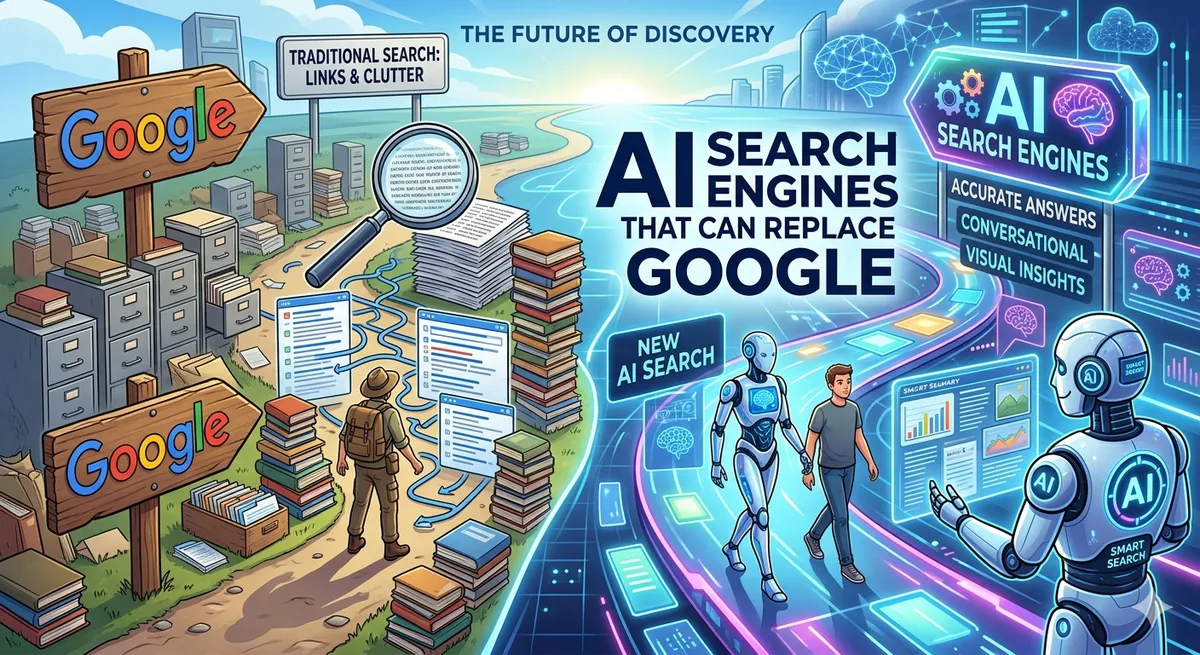
The Day I Stopped Googling Everything
I still remember the exact moment my search habits broke. I was trying to figure out something complicated, the kind of question that normally meant opening a dozen tabs and slowly assembling an answer from scraps across half of them. Out of curiosity I typed the whole messy question into one of the new AI search engines 2026 everyone kept mentioning. A few seconds later I had a clear, complete answer, with little numbered citations I could click to check. I sat there a little stunned. The thing I had been doing the hard way for twenty years had just gotten easy.
For most of my life, searching the web meant one thing: type some keywords, get a list of blue links, and start clicking. It was so normal that I never questioned it. Honestly, I was good at it. I knew how to phrase a query, how to spot the trustworthy result, how to dig past the ads. That skill felt permanent, like knowing how to read a map. And then, almost overnight, the map folded itself up and just told me where to go.
I want to talk about that shift, but not in a technical way, because I am not a technical person. I am just someone who searches the web constantly, the way we all do, for work and for life and for the random questions that pop into my head at midnight. What I noticed is that AI search changed not just how fast I find things, but how it feels to look something up at all. It went from a chore to a conversation. And like any big change, it came with a few hard lessons I learned the embarrassing way.
So this is part celebration and part warning. I genuinely love what AI search has done for my days. I also got burned a couple of times by trusting it too easily, and I learned where it shines and where the old way still wins. If you are curious whether these new search engines can really replace the one we all grew up with, let me just tell you what happened when I actually switched, mistakes and all.
Why This Matters in 2026
Here is why I think this is a bigger deal than it might sound. Search is not just a tool I use. It is basically how I think things through now. When a question comes up, my reflex for two decades has been to search it. So when the nature of searching itself changes, it quietly changes how I learn, how I make decisions, how I satisfy my own curiosity. That is not a small thing. It is the front door to almost everything I do online, and someone just installed a completely different door.
What struck me most is how much faster I get to the actual answer now. Most of my searches were never about finding a particular website. They were about understanding something or getting a question out of my head. The old way made me do the work of reading and reconciling a bunch of pages myself. The new way does that part for me and hands me the result. For someone as curious and impatient as I am, that gap between wondering and knowing shrinking to seconds is genuinely life-changing in a small daily way.
But I also feel a tug of something more complicated, and I think a lot of people do in 2026. All those websites I used to click through to, the blogs and guides and little corners of the internet that real people wrote, they were funded by my visits in a way I never thought about. If I get my answer without clicking, where does that leave them? I have started clicking the citations partly out of caution and partly out of a quiet sense that I owe it to the people who wrote what I am reading. That tension is real and I do not think anyone has solved it yet.
And then there is the simple fact that the giant we all assumed was permanent suddenly looks beatable. For my entire adult life, one search engine ruled everything, so completely that its name became a verb. The idea that I would willingly use something else for my everyday questions would have seemed absurd a few years ago. Yet here I am, doing exactly that, and so are a lot of people I know. When a habit that ingrained starts to crack, you know something genuinely significant is happening.
What Changed in How I Actually Search
The biggest surprise was not the speed. It was that searching turned into something more like talking.
From Keywords to Conversations
I used to translate my real question into keyword-ese, that clipped little language we all learned to speak to search boxes. With AI search I just ask the full, messy, human question, the way I would ask a knowledgeable friend. And then I can keep going. I ask a follow-up, then another, then circle back to clarify something. It remembers what we were talking about. The first time I did this without thinking, I realized I had stopped searching and started having a conversation, and I never wanted to go back.
The Tabs I No Longer Open
My old browser was a graveyard of forgotten tabs, the residue of every half-finished search. Those are mostly gone now, because the synthesis I used to do across all those tabs happens before the answer reaches me. I did not realize how much mental clutter that tab-juggling created until it disappeared. My searches feel calmer now, more focused, less like a frantic scavenger hunt and more like asking and receiving.
The Times It Burned Me
I do not want to oversell this, because AI search and I have had our fights, and a couple of them were my own fault.
The Confident Wrong Answer
Early on, drunk on how easy everything had become, I took an answer at face value for something that actually mattered. It sounded completely sure of itself, so I believed it. It turned out to be subtly wrong, and I only found out later, after it had already caused me a small headache. That was my wake-up call. These answers are fluent and confident in a way that can fool you, and fluency is not the same as being right. Now I treat a confident answer with a little healthy suspicion, especially when it matters.
Learning to Click the Little Numbers
The fix turned out to be sitting right there the whole time: those little citation numbers I had been ignoring. They link straight to the sources the answer is built on. Once I started actually clicking them on anything important, the whole experience got trustworthy again. Now it is a reflex. Big question, real stakes, I click through and check. It takes seconds and it has saved me from being fooled more than once. The citations are the safety net, and I had been performing without one.
When I Still Reach for the Old Way
I have not abandoned traditional search entirely, and I do not think I should.
When I Know Where I Am Going
If I already know the exact website I want, or I am trying to buy a specific thing, the old list of links is just faster. Asking an AI to synthesize an answer when I just want to land on a known page is like asking for directions to a house next door. For those moments, the plain old search box still wins, and I reach for it without a second thought.
When the News Is Breaking
For things happening right now, the very latest developments, I have found the raw results and real-time sources often beat the synthesized answer, which can lag a little behind the fastest-moving stories. So for breaking news I still go the traditional route. It taught me that this is not about one tool conquering the other. It is about knowing which one fits the moment.
How to Get Started
If you want to try this, I would not suggest going cold turkey on your old habits. What worked for me was just paying attention to what kind of question I was actually asking. When I caught myself wanting to understand something, compare options, or just satisfy a curiosity, I started reaching for AI search. When I knew exactly where I wanted to land, I kept the old way. Within about a week that choice became instinctive, and I stopped having to think about it.
The thing I would beg you to do, because I learned it the hard way, is to use the citations. Treat the first answer as the beginning of a conversation, not the final word, and click through to the sources whenever it actually matters. That one habit is the difference between AI search being a delightful shortcut and being a trap that occasionally fools you with a confident wrong answer. Ask your follow-up questions too. That conversational depth is where the real magic lives, and it is the part new users forget to use.
Common Mistakes to Avoid
My biggest mistake, the one that burned me, was trusting a confident answer without checking it. Please learn from me here. These answers sound certain even when they are wrong, and on anything that matters you have to verify. The fluency is seductive and the citations are right there. Use them.
The second mistake I made was ignoring those little citation links entirely at first. I treated them as decoration. They are not. They are the whole point of how you trust an AI answer. Clicking them turned my skepticism back into confidence.
A third mistake, which I see friends make, is forcing AI search to do everything, including the navigational and shopping tasks the old way handles better, and then concluding AI search is bad. It is not bad. It was just the wrong tool for that particular job.
The fourth mistake is accepting the first answer and walking away, never asking the follow-up questions that make AI search so powerful. You are leaving the best part on the table. And the last mistake, honestly, is refusing to try it at all because the old way feels safe. I almost made that one, and I would have missed something genuinely wonderful.
What I Wish Someone Had Told Me Earlier
Looking back on my whole journey with AI search engines, there are a handful of things I wish someone had just told me at the start, plainly, before I learned them the slow way. The first is that the awkward, clumsy early phase is completely normal and not a sign you are doing it wrong. Everyone goes through it. The tools feel strange, your first attempts are mediocre, and you wonder if the whole thing is overhyped. Push through that phase, because the good part is on the other side of it, and almost everyone who gives up does so before they get there.
The second thing I wish I had known is that it is okay to start embarrassingly small. I felt like I should be doing something impressive and ambitious right away, and that pressure nearly stopped me before I began. In truth, the small, almost trivial first step, the one that feels too modest to bother with, is exactly the right place to start. It builds the confidence and the understanding that everything else rests on, and there is no prize for skipping it. My best results all grew from a humble beginning I almost dismissed.
The third thing, and maybe the most freeing, is that you do not have to keep up with everything. I exhausted myself for a while trying to track every development in finding information online, every new option, every breathless announcement. It was not only impossible, it was counterproductive, because it kept me from going deep on the few things that actually mattered for my work. Letting go of the need to know it all was one of the most relieving and productive decisions I made.
The Mistakes I Keep Seeing Others Make
Now that I am a bit further along, I keep watching other people make the same mistakes I made, and I wish I could save them the trouble. The most common one is treating AI search as either a miracle or a fraud, when the truth is squarely in between. The people who expect magic get disappointed and quit; the people who expect nothing never give it a real chance. The ones who do well hold a more honest middle view: genuinely powerful, genuinely imperfect, and worth learning properly.
Another mistake I see constantly is people refusing to change their habits to fit the new way of working. They bolt AI search engines onto exactly how they did things before and then wonder why it does not help much. The real gains come when you are willing to rethink the workflow itself, to let the new capability reshape how you approach finding information online rather than just speeding up the old approach a little. That willingness to change is uncomfortable, but it is where the transformation actually lives.
The Quiet Wins That Add Up
What surprised me most, in the end, was that the biggest payoff did not come from one dramatic breakthrough. It came from a lot of quiet, small wins that added up over time. A task that used to take an hour now takes ten minutes. A thing I used to dread is now painless. A capability I never had is now just available to me. None of these felt like a revolution on its own, but together, accumulating week after week, they genuinely changed the texture of my work and gave me back something I did not expect: a sense of ease.
Where I've Landed
After all the trial and error, the false starts and the lessons, I have settled into a relationship with AI search engines that feels stable and sane, and I want to describe it because I think it is achievable for most people. I am not chasing every new thing anymore. I have a focused set of approaches I understand well and trust, I keep a casual eye out for genuinely better options, and I spend most of my energy actually using what I have rather than constantly hunting for something else. That stability, after the early chaos, feels like a small victory in itself.
I have also made peace with the imperfections. Ai search engines still surprise me occasionally, sometimes by being better than I expected and sometimes by stumbling on something I assumed they would handle. I no longer find this frustrating. I have built in the habits, the checking, the judgment, the willingness to step in, that turn those imperfections from a problem into a manageable feature of working with a powerful but fallible capability. That acceptance is what lets me rely on them without being burned by them.
Most of all, I have stopped seeing this as a thing happening to me and started seeing it as a thing I am doing, deliberately, on my own terms. The narrative around AI search engines can make you feel swept along, like you are either riding a wave or being left behind by it. Reclaiming the sense that I am the one steering, choosing what to adopt, how to use it, and where to keep the human firmly in charge, changed everything about how the whole experience feels. It went from anxious to empowering.
What I'd Tell a Friend Starting Out
If a friend asked me how to begin with AI search engines today, I would not hand them a list of tools or a pile of articles. I would tell them to pick one small, real thing in finding information online that they actually want help with, try one option against it for a little while, and pay honest attention to how it feels and what it saves them. I would tell them to expect the awkward early phase and push through it, to keep themselves in charge of anything that matters, and not to worry about all the things they are not doing yet.
And I would tell them the thing it took me longest to believe: that this is genuinely within their reach, whoever they are. The hype can make AI search engines feel like the domain of experts and early adopters, but the truth I have lived is that an ordinary person, willing to learn a little and stay deliberate, can get enormous value from this. You do not need to be technical or ahead of the curve. You just need to start small, stay honest about what works, keep yourself at the center, and give it the patience that anything worthwhile requires. That is the whole secret, and it is one anyone can follow.
The Bigger Picture, In My Own Words
When I step back from all the specifics, what strikes me most about my whole experience with AI search engines is how much it changed not just my work but the way I feel about my work. I used to carry a low hum of being perpetually behind, of there always being more than I could get to. As I got comfortable with AI search in finding information online, that hum quieted. Not because everything got done, it never does, but because I stopped having to do all of it myself, and that shift turned out to matter more for my peace of mind than I ever expected.
I also think there is something a little profound in learning to delegate to a capable tool, even beyond the time it saves. It forced me to get clearer about what I actually want, because you cannot hand off a task you cannot articulate. It made me distinguish the parts of my work that are genuinely mine, the judgment, the care, the relationships, from the parts that were just consuming me without needing me. That clarity was a gift hidden inside the practical benefit, and I did not see it coming.
If there is one thing I would want someone to take from my story, it is that you get to do this on your own terms. The noise around AI search engines can make you feel like you are being swept along by a current you did not choose. But I have found the opposite to be true once you engage deliberately. You choose what to adopt, how far to trust it, where to keep yourself firmly in charge, and what pace feels sustainable for you. The agency is yours the whole time, and reclaiming that feeling changes the entire experience from something stressful into something genuinely good.
So that is where I have landed, and where I hope you can land too: not breathless, not behind, not anxious about everything I am not doing, but steadily and contentedly getting real value from AI search engines in finding information online, on terms that fit my life. It took some stumbling to get here, and I would not pretend it was effortless. But it was worth it, and the door is open to anyone willing to start small, stay honest, and keep the human, you, at the center of it all.
Frequently Asked Questions
Did you really stop using Google entirely?
Not entirely, and I do not think you should either. I switched most of my questions, comparisons, and curious midnight rabbit holes to AI search because it is just better for those. But when I know the exact site I want, or I am shopping, or I need breaking news, I still use traditional search. It turned out to be less of a divorce and more of an open relationship between the two.
Can AI search really be trusted?
Mostly yes, if you do one thing: click the citations on anything important. The answers are grounded in real sources and they link to them. The trouble only comes when you trust a confident answer blindly, which is exactly the mistake that burned me once. With the verify-when-it-matters habit, I trust it for the vast majority of my searches.
What kind of questions is it best for?
Anything where you want to understand, compare, or explore. Big messy questions that used to mean a dozen tabs are where it absolutely shines, because it does the tab-juggling for you. For just understanding a topic or satisfying curiosity, it is dramatically better than the old way. For finding a known website or buying something, less so.
Is it hard to switch from regular search?
Honestly, no. There is nothing technical to learn. You just type your real question in plain language instead of keyword-ese, and you can keep the conversation going with follow-ups. The only adjustment is a mental one: getting used to asking like you would ask a person, and remembering to click the citations. It took me about a week to feel natural.
What happens to all the websites if everyone uses AI search?
This is the part that genuinely worries me too. Those websites were funded by our clicks, and if we stop clicking, it gets harder for the people who write them. That is partly why I make a point of clicking the citations, both to verify and to send a little traffic to the sources. Nobody has fully solved this tension yet, and I think it matters that we keep paying attention to it.
Have you ever been seriously misled by an AI answer?
Once, early on, before I learned to verify. I trusted a confident answer on something that mattered and it was subtly wrong, which caused me a small but real headache. That single experience taught me the verify-the-citations habit that has kept me safe ever since. So yes, but it became the most useful lesson I got out of the whole switch.
Do you still get a list of links at all?
Sometimes, depending on the engine, alongside the synthesized answer, and I am glad for it. When I want to go deeper or verify, having the raw sources right there is reassuring. The best experiences give me both: the quick answer for convenience, and the links underneath for when I want to dig in myself. I use both parts depending on my mood and the stakes.
Is your privacy safe with these engines?
It depends which one you pick, the same as it always did with search. Some are more privacy-focused than others. I read the policy before settling on the ones I use regularly, and I never type genuinely sensitive personal stuff into any search box, AI or not. That basic caution served me well with old search and it serves me just as well now.
Will you ever go back to the old way of searching?
For most of my questions, no, I really cannot imagine it. Once searching became a conversation that hands me answers in seconds, the old tab-juggling scavenger hunt feels almost quaint. But I will keep the old way around for the specific jobs it still does best. Going back fully would feel like trading a conversation for a card catalog, and I am not willing to do that.
Conclusion
The day I stopped Googling everything was not some grand decision. It was a small moment of surprise that quietly rearranged a twenty-year habit. AI search took the thing I did the hard way my whole life, the tab-juggling, the keyword-translating, the scrap-assembling, and turned it into a conversation that simply gives me the answer. For most of my questions, I am genuinely not going back, and I did not expect to feel that strongly about a search engine of all things.
But the lessons stuck with me as much as the wonder did. Trust the answers, but click the citations when it matters, because confidence is not the same as correctness. Keep the old way around for finding known sites, shopping, and breaking news, where it still wins. And spare a thought for the websites that feed these answers, because clicking through is both how you verify and how you keep the open web alive. Do that, and AI search becomes what it became for me: not a replacement for thinking, but a faster, friendlier way to do it.
Want to stay updated?
Get the latest AI tool reviews and news delivered to your inbox.